


Dubai – Qahwa World
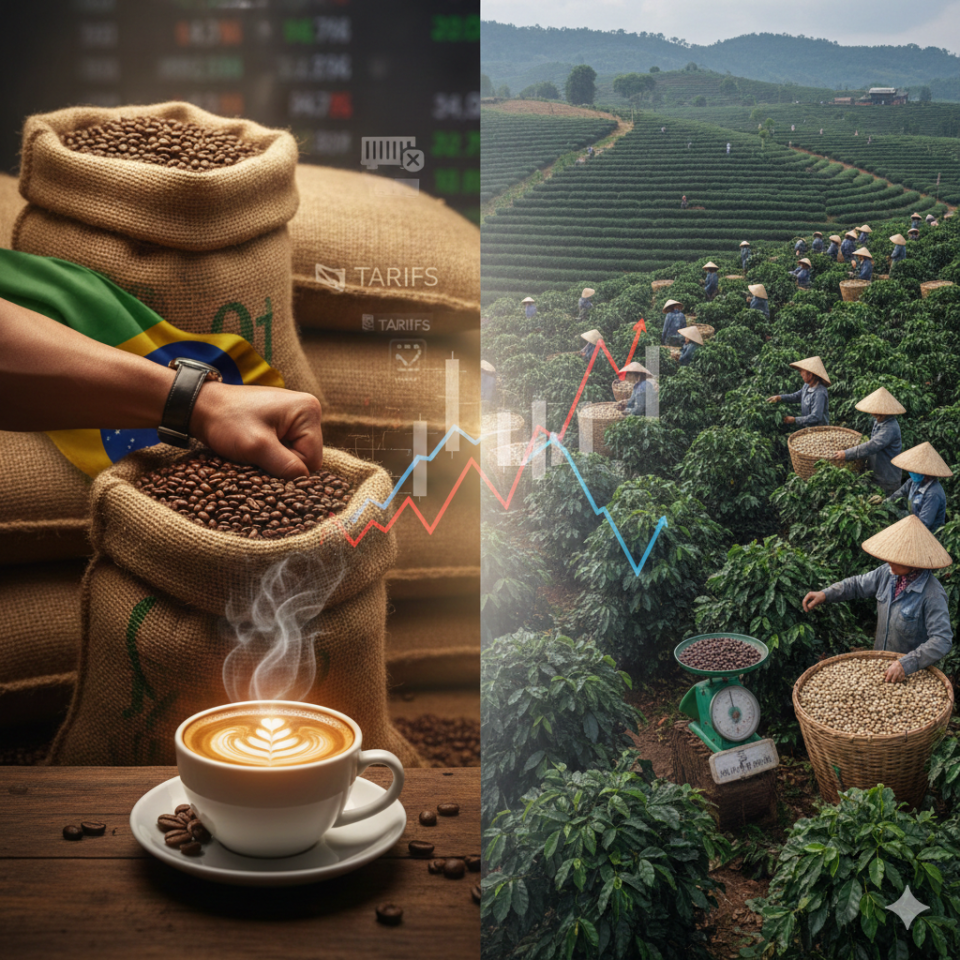
March arabica coffee (KCH26) rose slightly by +0.15 (+0.04%) on Tuesday, while January ICE robusta (RMF26) slipped -15 (-0.34%), hitting a 1.5-week low. The day’s movements reflect a split market, with arabica gaining support from a stronger Brazilian real, now at a two-week high against the US dollar. The firmer currency is discouraging export sales from Brazil’s growers, helping arabica prices edge upward.
Robusta, however, is under pressure. The Vietnam Coffee and Cocoa Association reported that around 10% of the country’s robusta harvest is now complete and forecasted that expected drier weather will accelerate harvesting through the month. Vietnam is the world’s largest robusta producer, and signs of increased output continue to weigh on prices.
Weather conditions in Brazil are offering some support to the market. Somar Meteorologia noted that Minas Gerais—Brazil’s main arabica-producing region—received only 20.4 mm of rain in the week ending November 28, equivalent to 39% of the historical average.
Coffee inventories monitored by ICE continue to tighten. US tariffs on coffee imports from Brazil triggered a sharp drawdown in stocks. ICE-certified arabica inventories reached a 1.75-year low of 398,645 bags on November 20, while robusta inventories fell today to an 11-month low of 4,115 lots. American buyers have cancelled new Brazilian coffee contracts due to the tariffs, tightening domestic supply. US imports of Brazilian coffee from August to October fell 52% year-on-year to 983,970 bags.
On the policy side, the outlook for ample supply strengthened after the European Parliament approved a one-year delay to the European Union’s anti-deforestation law (EUDR). The postponement allows EU members to continue importing agricultural commodities—including coffee—from regions in Africa, Indonesia, and South America where deforestation remains a concern.
Several supply signals are weighing on the market. StoneX recently projected Brazil’s 2026/27 crop at 70.7 million bags, including 47.2 million bags of arabica, a 29% year-on-year increase. Vietnam’s supply outlook also remains heavy: its Jan–Oct exports rose 13.4% year-on-year to 1.31 MMT, and 2025/26 production is expected to grow by 6% to 1.76 MMT (29.4 million bags), a four-year high. Vicofa additionally suggested that Vietnam’s 2025/26 output could rise by 10% if favorable weather continues.
Some indicators continue to signal tightening global supply. The International Coffee Organization reported that global exports for the current Oct–Sep cycle slipped 0.3% year-on-year to 138.658 million bags. In Brazil, Conab cut its 2025 arabica estimate by 4.9% in September, lowering the projection to 35.2 million bags. Total Brazilian coffee output was trimmed to 55.2 million bags.
Longer-term forecasts from the USDA’s Foreign Agriculture Service expect global production to rise 2.5% in 2025/26 to a record 178.68 million bags. The outlook includes a 1.7% decline in arabica output to 97.022 million bags, alongside a 7.9% increase in robusta to 81.658 million bags. Ending stocks are projected to rise 4.9% to 22.819 million bags.
