Author: Qahwa World |
Date: June 14, 2026
Coffee Market Between Today’s Tightness and Tomorrow’s Abundance: How May 2026 Numbers Reveal a Sharp Disconnect
What Is Happening in the Coffee Market Today?
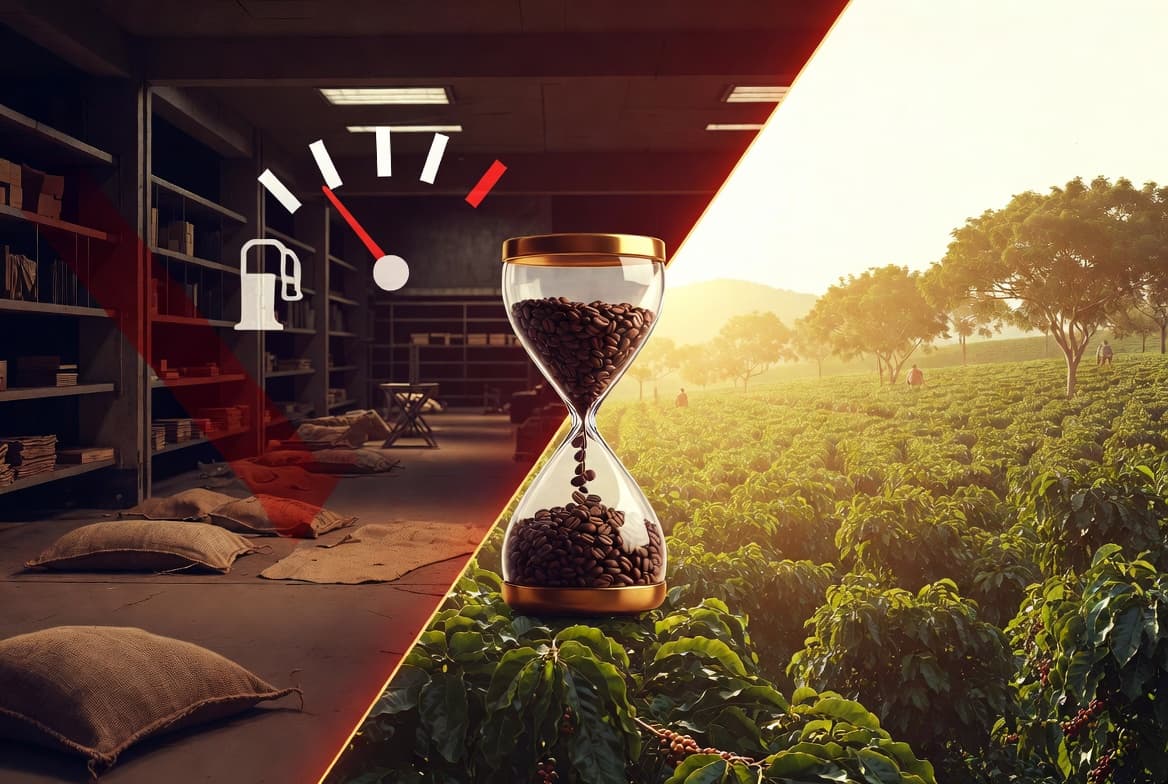
- The coffee market is living a stark contradiction: spot inventories are shrinking while record surplus expectations are rising.
- NY‑certified arabica stocks plunged 13.5% to 0.48 million bags – a multi‑month low.
- At the same time, Brazil raised its 2026/27 production forecast to a record 66.7 million bags, with arabica alone jumping 28% y/y.
- The market is pricing based on “future abundance” expectations, ignoring current physical tightness.
- This disconnect creates a highly volatile environment: any additional disruption could trigger a sharp price spike.
- Importers and roasters face a strategic dilemma: how to balance immediate supply needs against the risk of a price collapse later.
If you look at the May 2026 coffee market figures, you will find yourself facing two completely different markets inside one. The first market talks about shrinking inventories falling to multi‑month lows, about difficulties in securing immediate supplies. The second market promises a record surplus driven by an exceptional Brazilian crop that could reshape the global balance for years.
This contradiction is not just a statistical curiosity. It reflects a deep crisis of confidence between what exists today and what the market expects tomorrow. In this analysis, we examine the main features of this disconnect and explore its consequences for importers, roasters, and decision‑makers in the global coffee industry.
1. Inventories Are Crashing – A Warning Signal That Cannot Be Ignored
Despite all the talk about a surplus, the ICO numbers point to a very different reality on the ground. In May 2026, NY‑certified arabica stocks plunged 13.5% to just 0.48 million bags – the lowest level in months. Similarly, London‑certified robusta stocks remained near two‑year lows.
What this number means is simple: immediate physical supply of high‑grade coffee is running out. The market is currently suffering from genuine pressure on available stocks. This is not a reflection of weak production, but rather the result of several interacting factors: supply chain disruptions, slower deliveries, and possibly traders preferring to hold back inventory in anticipation of higher prices.
What is striking is that these shrinking stocks have not yet translated into a sharp price rally. That is exactly what deserves attention.
2. Brazil Announces a Historic Season – A Surplus That Could Rewrite the Rules
On the opposite side of the equation, CONAB raised its forecast for the 2026/27 Brazilian crop to a record 66.7 million bags. Beyond the headline number, the most striking figure is the huge jump expected in arabica production alone: up 28% year‑on‑year to 45.8 million bags.
This leap is not just a number on a table. It is the main factor feeding market expectations of a large surplus that could reach 10 million bags in coffee year 2026/27. Since the market is currently pricing based on “tomorrow’s expectations” rather than “today’s realities”, this massive number is the primary driver of the downward pressure we have seen on prices in recent months.
| Indicator | Trend | Implication | ||||||
|---|---|---|---|---|---|---|---|---|
| Exchange stocks (NY arabica) | ▼ 13.5% | Acute spot tightness | Brazil production forecast (arabica) | ▲ 28% | Expected future surplus | ICO Composite Indicator (I‑CIP) | ▼ 3.8% | Pricing based on expectations, not reality |
3. The Paradox – Why Are Prices Ignoring Current Physical Tightness?
Here lies the hardest question: why are prices not rising in response to falling spot inventories? The answer reflects a fundamental shift in how the market is pricing. It seems that traders are now basing their decisions on long‑term future expectations rather than current realities. The record Brazilian crop forecast appears so heavy that it overshadows all immediate scarcity signals.
This shift in market behavior is not necessarily healthy. It creates a condition of high fragility. If for any reason that record crop fails to materialise – drought, floods, logistical disruptions – the market will suddenly face two painful realities at once: already depleted spot inventories and a surplus that never arrived. The likely outcome would be a sharp price spike that could catch everyone off guard.
4. What This Means for Importers and Roasters – A Strategic Dilemma
For importers and roasters, this paradox creates one of the most difficult strategic dilemmas imaginable:
- On one hand: Spot inventories are tight and prices remain historically high. The need to secure immediate supplies is urgent.
- On the other hand: Any long‑term supply contract signed today could become a heavy burden if the record surplus materialises and prices collapse in the second half of the year.
- The bottom line: Everyone is waiting. Buyers are waiting for a price collapse that may not come. Sellers are waiting for a rally that may not happen. The market is suspended in an uncomfortable grey zone.
The most prudent strategy at this time may be short‑term diversification rather than long‑term commitments. Flexible supply contracts, phased purchasing in small increments, and close monitoring of weather developments in Brazil may be the wisest approach in this uncertain phase.
5. The Market Is Pricing a Fiction, but Reality May Have Its Own Say
The disconnect we see today between falling spot inventories and record surplus expectations is not merely a statistical anomaly. It reflects a change in market psychology. Traders have heavily bet that the record Brazilian crop will satisfy all demand and more. But history teaches us that weather, logistics, and supply chains do not always follow optimistic scenarios.
If the surplus materialises as expected, prices may face further downward pressure. But if the Brazilian crop is negatively affected by weather or El Niño, the market could sharply refocus on the reality of tight spot inventories, generating an unexpected upward spike. In either case, caution remains the most important watchword.
Frequently Asked Questions About Coffee Market Contradictions
Q: How can inventories fall while the market expects a surplus at the same time?
A: Inventories reflect the immediate present. Surplus expectations are based on the future Brazilian crop. The time gap between present and future is the source of the contradiction.
Q: Why are tight inventories not pushing prices higher?
A: Because the market is currently focused on “future abundance” expectations. Those heavy expectations weigh on prices and prevent them from reacting to current tightness.
Q: What is the most likely scenario for the coming months?
A: High volatility will be the main theme. Any weather or logistical development could sharply change the price direction in either direction.
Q: What do you advise importers and roasters at this time?
A: Avoid long‑term commitments. Use short‑term, flexible contracts. Monitor weather developments in Brazil very closely.
Q: Could we see a price collapse soon?
A: Not necessarily. Low inventories provide a floor that could prevent a major collapse even if a surplus materialises.
The coffee market today tells a complex story that cannot be understood through a single number. It is a story of a market torn between a tight present and an abundant future. The true professionals are those who can read between the lines and see that the greatest risk may not be the surplus itself, but the surprises that might appear on the road to it.
Analysis by Qahwa World – Based on the International Coffee Organization (ICO) market report for May 2026.
All rights reserved. Republication with attribution permitted.
Publication date: June 14, 2026