Dubai – Qahwa World
Walk down a Jakarta side street at 7 a.m. and you can watch Indonesia’s coffee story unfold in real time: a plastic stool at a warung, a QR code on a grab-and-go kiosk, and a young professional ordering a single-origin pour-over on her way to the office. Indonesia is no longer just a coffee origin on a cupping table in Europe or the US; it is becoming one of the most dynamic coffee-drinking countries in the world.
Over the past decade, and especially since the pandemic, Indonesians have quietly transformed their relationship with coffee—from dark, sugar-laden robusta in glass cups to iced specialty beverages ordered through delivery apps and omakase-style tasting bars in the capital. The result is a market that is maturing on several levels at once: economically, culturally, and sensorially.
- A producer that learned to drink its own coffee
Indonesia has long been a heavyweight in green coffee production, growing both arabica and robusta across islands like Sumatra, Java, Sulawesi, and Flores. The country contributes about 5% of global coffee exports and generates well over US$1.5 billion in export revenue from coffee each year, placing it among the world’s top producers.
For decades, much of that coffee left the country, while domestic drinkers were served largely commodity-grade robusta, roasted dark and drowned in sugar, condensed milk, or spices. The local market revolved around warungs, kopi tubruk at home, and bustling kopitiams where coffee was one part caffeine, one part nostalgia.
What has changed is not only volume, but intent. Domestic consumption has surged, with coffee drinking shifting from a habit of necessity or tradition into a lifestyle that young Indonesians actively curate. Deloitte and other market analysts now point out that Indonesia’s coffee consumption has tripled compared with pre-pandemic levels, pushing it into the ranks of the world’s top five coffee-consuming countries. At the same time, analysts estimate the value of the country’s coffee market could reach roughly US$12.6 billion by 2030 if current growth continues at around 5% a year.
This turn inward matters. In a global market increasingly shaken by climate shocks and price volatility, a strong domestic demand base gives producers and roasters more options—and more leverage—than relying on export markets alone.

- Chains, kiosks, and a new middle ground
To understand Indonesia’s current boom, it helps to look at what happened between the traditional warung and the high-end café. When international chains first arrived in the early 2000s, they brought espresso-based beverages and a new café aesthetic—but at a price point that was out of reach for many, with a single cup easily costing more than a third of the median daily income at the time.
Local entrepreneurs spotted the gap. Brands like Kopi Kenangan built their model on an accessible promise: modern coffee, familiar flavours, and digital convenience at a fraction of international chain prices. Founded in 2017, Kopi Kenangan expanded at breakneck speed, reaching roughly 900 stores across Indonesia by early 2025 and proving that there was appetite for something between the plastic stool and the plush armchair.
Their success coincided with a broader shift toward convenience formats. A wave of ready-to-drink (RTD) bottles, small grab-to-go kiosks, and café counters inside convenience stores—such as FamiCafé—pushed coffee into transit hubs, malls, petrol stations, and office towers. During the pandemic, this convenience-first model was supercharged: a study of Indonesia’s coffee market found that takeaway and online coffee orders rose by more than 5%, while average ticket sizes climbed from one drink per order to three as consumers leaned on delivery apps for their daily caffeine fix.
Today, Indonesia’s coffee landscape feels layered rather than linear. On the same street, you might see:
-
A traditional kopitiam serving kopi susu with breakfast.
-
A domestic chain offering flavoured iced lattes at a mass-market price.
-
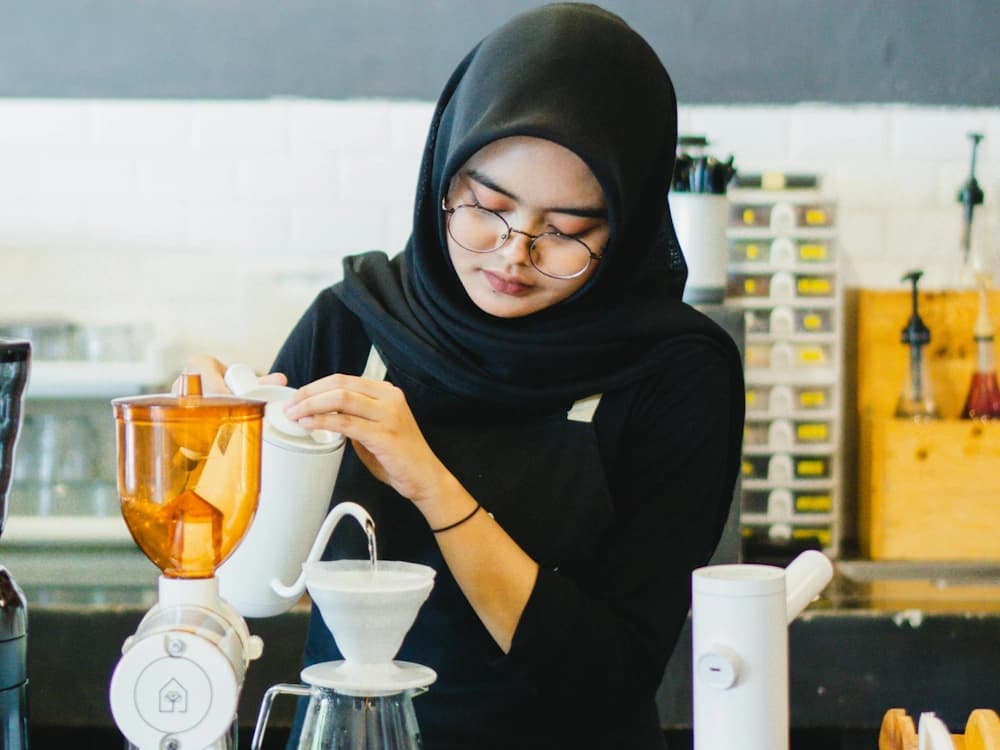
A specialty barista weighing single-origin beans on a scale.
Instead of one model replacing another, they are stacking on top of one another—each speaking to a different moment, budget, and taste preference.

Demographics are doing a lot of heavy lifting in Indonesia’s coffee story. Roughly 40% of the population is between 20 and 40 years old, a cohort that has more disposable income than their parents and a very different attitude toward consumption. Coffee is not just fuel; it is part of how they signal identity, spend time with friends, and document their day on social media.
Culture has played its role too. The 2015 release of Filosofi Kopi, a film centred on a specialty coffee shop in Jakarta, helped bring barista culture and single-origin storytelling into mainstream conversation. Café work, once viewed as a stopgap job, began to look like a creative, aspirational profession. Many young Indonesians saw in coffee a way to blend craft, hospitality, and entrepreneurship.
This shift is visible in the sheer number of cafés and coffee stalls that have opened over the last decade. Industry stakeholders now describe Indonesia as one of the countries with the highest café counts in the world, driven by small entrepreneurs, local chains, and increasingly sophisticated independent shops. In major cities, weekend “café-hopping” has become a common pastime for Gen Z and young professionals, who are as interested in interior design and latte art as they are in origin stories.
- Jakarta’s specialty vanguard—and beyond
If chains and kiosks are the mass engine of growth, Jakarta’s specialty scene is the R&D lab. The city has become a playground for roasters, baristas, and café owners who want to push the sensory and experiential boundaries of coffee.
One of the most visible figures in this movement is Mikael Jasin, 2024 World Barista Champion and three-time Indonesia Barista Champion. His Jakarta concept, Omakafé, applies an omakase-style format to coffee, guiding guests through multi-course tasting experiences that showcase different origins, processes, and brew methods. The format signals something important: Indonesian consumers are increasingly willing not just to drink coffee, but to be educated, surprised, and entertained by it.
Jasin also serves as Chief of Coffee Innovation at Fore Coffee, a domestic specialty chain that raised around Rp 353.44 billion (approximately US$21 million) in an initial public offering on the Indonesia Stock Exchange. Following its IPO, Fore launched an experience-focused store in South Jakarta’s Panglima Polim area, centered on a slow bar where baristas talk guests through flavour profiles, extraction, and the differences between Indonesia’s growing regions.
Specialty is not staying in the capital. Cities like Surabaya, Bandung, Medan, and Bali are seeing a wave of new roasteries and cafés, ranging from minimalist espresso bars to drive-thru outlets connected to local chains. Brands such as Expat. Roasters have used airports and high-traffic locations as gateways, introducing both domestic and international travellers to Indonesian specialty coffee on their way in and out of the country.
Events have amplified this momentum. In May 2025, the World of Coffee trade show came to Jakarta for the first time, bringing international buyers, equipment manufacturers, and coffee professionals into direct contact with Indonesia’s rapidly evolving scene. Organisers noted not just the energy on the show floor but the diversity of approaches—from experimental processing and origin-focused menus to highly localised drink concepts that foreground Indonesian flavours.

- A market growing in many directions at once
Looking at the numbers, there is little sign that Indonesia’s coffee boom is a short-lived trend. USDA forecasts for 2024/25 predicted domestic consumption at around 4.8 million 60 kg bags, up by 10,000 bags year-on-year, even as some export volumes softened due to production challenges. That apparent contradiction—strong local demand alongside tighter export supply—suggests more of Indonesia’s coffee is staying at home, and importantly, that more of it is being consumed in higher-value formats.
Crucially, growth is not confined to one end of the market. High-end specialty bars and omakase experiences are expanding at the same time as affordable grab-and-go concepts and convenience-store counters like FamiCafé. Together, they are building what industry observers describe as a multi-layered coffee ecosystem, where consumers can trade up or down depending on the occasion without leaving the category.
The pandemic also left a structural imprint on behaviour. As delivery apps became a habitual part of daily life, coffee companies used them not just as logistics channels but as discovery tools—testing limited-time flavours, seasonal drinks, and co-branded collaborations that could be scaled up if they went viral. This test-and-learn approach has kept the market nimble and responsive to shifting tastes, especially among younger drinkers.
At the same time, the steady rise of ready-to-drink and bottled coffee formats has opened new profit pools beyond the café counter. RTD options now sit in fridges in supermarkets, mini-marts, and even small neighbourhood shops, extending coffee consumption into moments and locations that a traditional café could not reach.
- Taking Indonesian coffee culture abroad
As domestic demand matures, Indonesian coffee concepts are traveling. Kopi Kenangan was among the first homegrown chains to test international waters, rolling out stores in markets such as India, Australia, Singapore, Malaysia, and the Philippines. Their proposition—sweet, iced, and often dairy-forward beverages at accessible prices—translates well in other parts of Asia-Pacific where climate, income levels, and taste preferences are broadly similar.
Other Indonesian brands have followed, with Fore Coffee opening in Singapore to tap into that city’s role as a regional hub for café culture and food trends. These expansions function as both business experiments and cultural exports: they carry Indonesian flavour combinations, branding, and service styles into markets that are already crowded with global coffee names.
On a smaller scale but with significant symbolic impact, Indonesian-owned and Indonesian-inspired specialty cafés have started to appear in cities across the United States, a country that imports around 12% of Indonesia’s coffee. Spots like Kopiku in San Francisco, DUA DC in Washington, D.C., and Hijau in San Jose build their identities explicitly around Indonesian origins and culture, moving international perception beyond the usual shorthand of “Sumatra” or kopi luwak.
These cafés are often where international consumers encounter drinks like kopi susu, pandan lattes, or beverages sweetened with palm sugar (gula merah) for the first time. As Kangmin Kim of Exporum notes, globalisation and social media now make it far easier for these Southeast Asian-inspired drinks to gain attention, with a single viral post capable of propelling a niche menu item into mainstream curiosity.

- Authenticity, accessibility, and what comes next
If there is a single through-line in Indonesia’s specialty coffee journey, it is the pairing of authenticity with accessibility. Rather than abandoning traditional flavours and formats, many of the most successful brands have reinterpreted them—bottled es kopi susu sold online during the pandemic, pandan- or palm-sugar-inflected lattes served in sleek urban cafés, or single-origin flights built around Indonesian terroirs that local drinkers can claim as their own.
Indonesia’s young, urbanising population, rising incomes, and long-standing coffee culture give it a rare combination of depth and momentum. The country is simultaneously a major producer and an increasingly sophisticated consumer, with domestic chains and independent shops continuously testing the limits of what coffee can be and who it is for.
The question now is less whether Indonesia’s coffee market will continue to grow, and more how far its influence will reach. As local chains expand regionally, RTD formats travel, and Indonesian-inspired cafés multiply abroad, the flavours and formats born in Jakarta, Surabaya, or Medan are likely to shape how the world drinks coffee in the decade ahead.