Dubai – Qahwa World
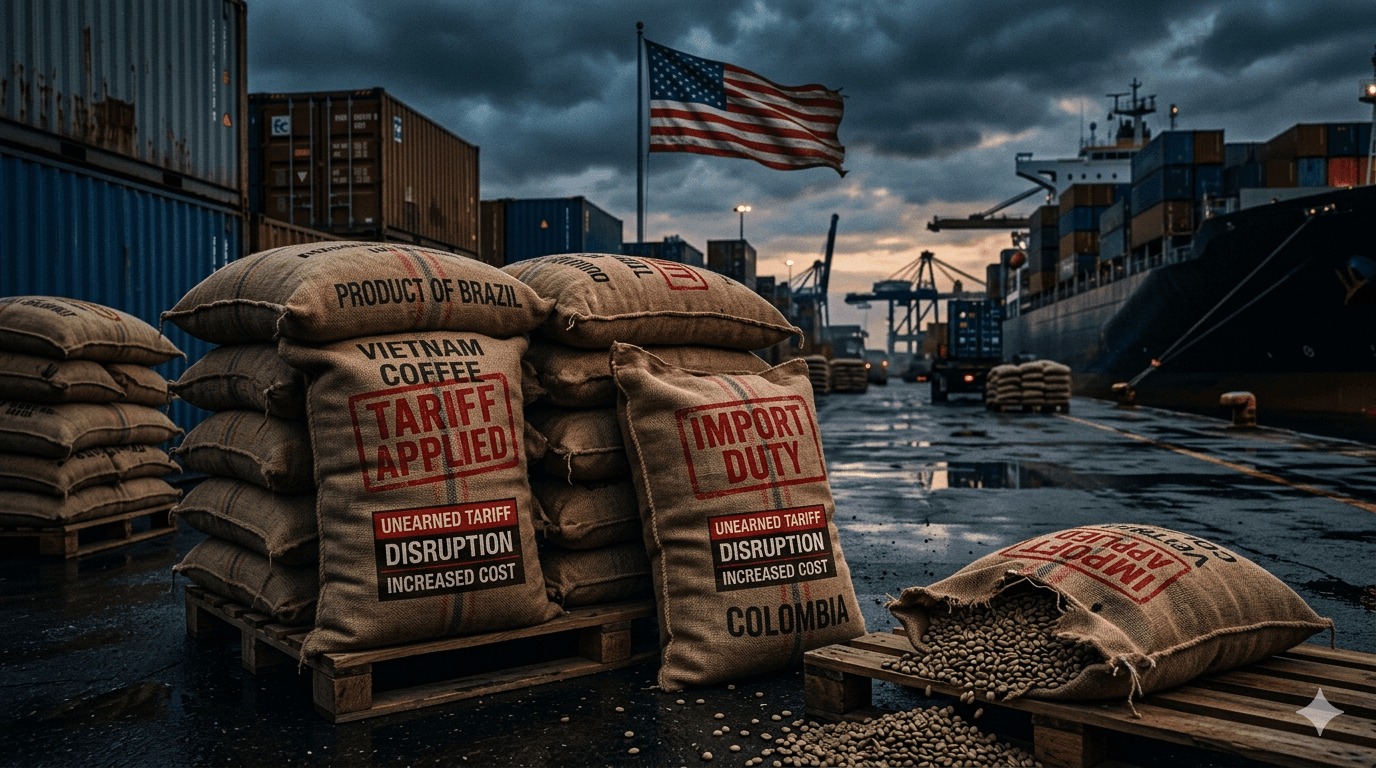
Tariff policies introduced during 2025 have contributed to significant shifts in the global coffee trade, pushing industry players to rethink supply chains and accelerate structural changes across the sector.
In 2025, broad tariff measures were imposed on imports of green coffee beans and roasting equipment. The initial rate started at around 10%, but in some cases increased substantially on major coffee-producing countries such as Brazil, Vietnam, Indonesia, and Mexico.
These measures were not applied consistently over time. Later adjustments, exemptions, and partial rollbacks were introduced following trade negotiations and policy revisions, including relief for certain agricultural goods that are not domestically produced, such as coffee. Despite this, the early phase of the tariffs had already created noticeable disruption.
The impact included higher roasted coffee prices in certain markets, shifts in export flows, and widespread instability across global supply chains.
- Supply Chain Disruption
The changes exposed how sensitive the global coffee system is to trade policy shifts. Key developments included:
A decline in exports from Brazil to the United States, with redirected shipments toward Asia and the Middle East
Increased tariff pressure on exports from Vietnam, Indonesia, and Mexico, pushing buyers to search for alternative origins
Rising costs for coffee equipment such as grinders and espresso machines due to import dependencies
Frequent policy changes made long-term planning difficult, increasing operational uncertainty and raising costs across the supply chain.
- Beyond Beans: Equipment and Infrastructure
The impact was not limited to green coffee. Imported roasting and café equipment also became more expensive, increasing the cost of opening or upgrading coffee shops.
This added pressure came on top of ongoing global supply chain disruptions, including higher raw material costs and shipping delays in recent years.
- Market Adaptation Strategies
As costs rose, market participants explored different ways to adapt, including:
Rerouting shipments through countries with lower tariff exposure
Reclassifying origin within multi-stage production chains
Establishing roasting and packaging operations in third countries to alter customs classification
Large multinational companies were generally better positioned to implement such strategies due to capital availability and infrastructure flexibility.
- Historical Context of Coffee Trade Workarounds
Attempts to bypass trade restrictions are not new in coffee history. Over centuries, coffee spread globally through a mix of legal trade, secrecy, and strategic relocation of plants and beans.
Historical examples include:
Early movement of coffee cultivation from its origin regions into Asia and the Americas through controlled and often restricted transfers
The spread of coffee plants to Southeast Asia and Latin America via maritime trade routes in earlier centuries
Historical episodes in Europe where coffee was heavily taxed or restricted, leading to informal trade networks and enforcement efforts
These patterns show that trade restrictions have historically encouraged alternative distribution channels.
- Shifting Global Demand
Several broader trends accelerated during this period:
Growth in coffee consumption in Asia and the Middle East
Expansion of domestic consumption in producing countries
Increasing focus on supply diversification by major importers
Stronger regulatory attention in some markets on sustainability and climate-related sourcing
Together, these shifts suggest a gradual rebalancing of global coffee consumption and trade flows.
- Uncertain Long-Term Outcomes
The long-term effects of these tariff-related disruptions remain unclear. Some analysts expect elevated price levels to persist even after policy normalization, due to accumulated supply chain inefficiencies.
While tariffs are often intended to support domestic industries, the observed effects in many cases have included:
Increased costs for importers and roasters, particularly smaller businesses
Higher consumer prices in retail and café markets
Reduced supply chain efficiency due to rerouting and compliance complexity
Limited direct benefit to producers in developing countries in many cases
Larger companies have generally been better able to absorb shocks, potentially contributing to greater consolidation within the industry.
- Conclusion
The tariff developments of 2025 may represent a turning point in the global coffee trade system. Combined with shifting consumption patterns, rising new markets, and evolving supply chain strategies, the industry appears to be entering a new structural phase.
The key question moving forward is whether these changes will lead to a more resilient and balanced global coffee economy, or further concentrate influence among large multinational players.
Coffee has always moved across borders in response to economic and political pressure. Once again, it is adapting—reshaping itself along with the global systems that depend on it.