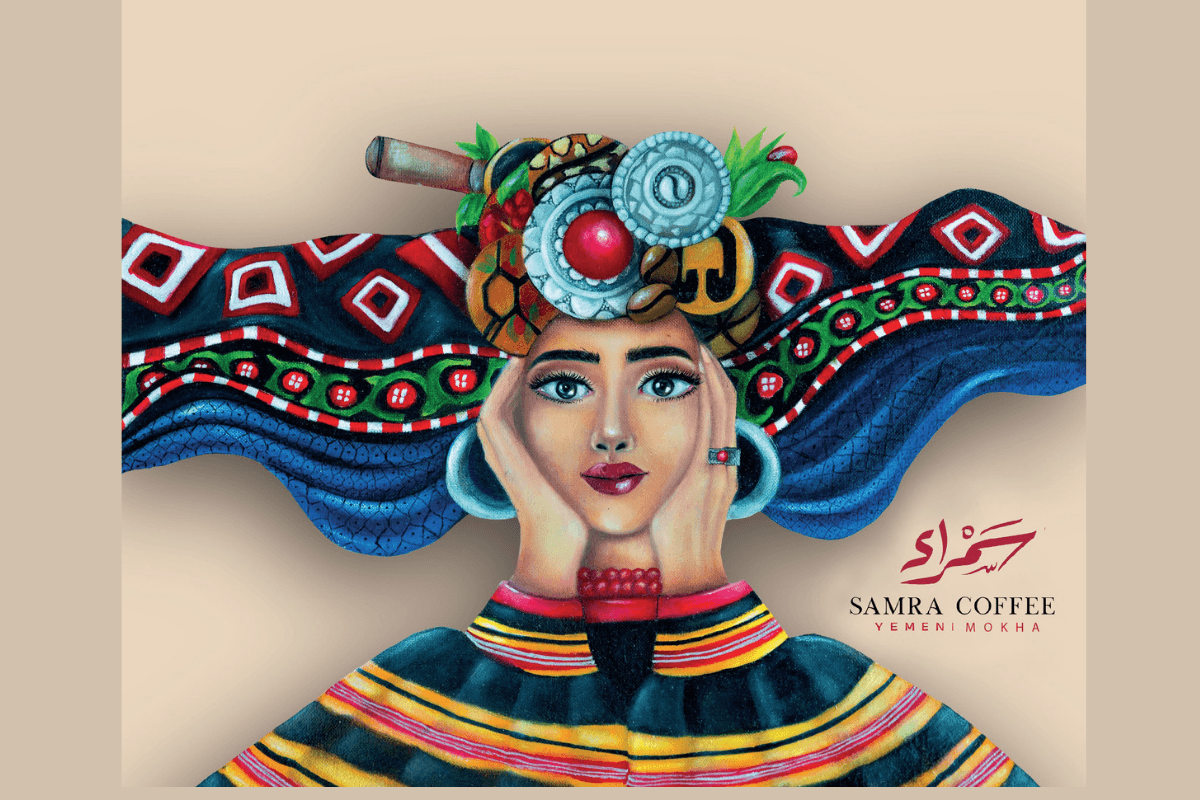
Dubai – Ali Alzakary
In the midst of displacement and the search for self, Sara Al-Haj wasn’t just looking for a “project”; she was searching for a “footprint” to leave in this world. A daughter of Taiz whose life was tempered in Al-Hudaydah, she forged her destiny in Sana’a within a coffee “Jazwa.” Amidst the ashes of war, she crafted a future that no one believed in but herself.
- “Samra”.. From a Faded Fashion Dream to the First Women-Led Brand
The story began long before coffee. In Al-Hudaydah, Sara dreamt of a traditional Abaya project named “Samra”, inspired by an old Lebanese series she used to watch, feeling the name mirrored her own authentic bronze features. However, the 2019 war shattered those dreams before they could see the light, forcing Sara to flee to Sana’a with a suitcase full of memories and a broken heart.
In Sana’a, amidst the void of displacement, she watched the music video “Al-Hob Wal-Bunn” (Love and Coffee) by artist Ahmed Seif. A spark ignited in her mind: “Why not enter the world of coffee?” Sara searched all over Yemen for a woman who had established an officially registered coffee brand, but she found none. It was then she decided to be the first Yemeni woman to break the male monopoly in this historic market, resurrecting “Samra Coffee“—but this time, through coffee beans.
- The Logo.. A Yemeni Face Carrying Sara’s Message to the World
The “Samra” logo was never just a graphic design; Sara wanted the product to carry her soul and message. She collaborated with her designer (then living in Malaysia) to sketch a girl whose features and details embodied an authentic Yemeni woman, intertwined with traditional heritage.
Sara says, “Since I do not appear personally, I wanted the logo to speak for me and for the role of Yemeni women. I wanted the product, as it travels abroad, to convey an honourable image of girls in Yemen.” Today, this face has become the identity and the official seal for “Samra” in all its governmental and commercial dealings.
- Starting with Daily Allowance and a Mother’s Kitchen
Sara started with a very modest capital—200,000 Yemeni rials—an amount she painstakingly saved from her personal allowance. In a small room in her family’s house, she turned her mother’s kitchen into a laboratory for four full years.
Lacking basic professional machinery, Sara roasted her coffee using a “Tefal pan” and a manual “spoon”, grinding it with a simple home grinder gifted by her mother. Since she couldn’t afford professional courses, she visited major merchants, carrying a small notebook and a pen, asking about every secret and documenting every detail. Those merchants nicknamed her “The Journalist” because of her immense thirst for knowledge.
That struggle was not in vain. Today, thanks to God, the “Samra” project has achieved the financial independence Sara always aspired to as a displaced girl, becoming the fruit of her labour that supports her and her family with pride.

- The Battle of the “Jazwa” and the Woven Prophecy
Sara faced a war of bullying and frustration. Some specialists mocked her, saying, “You are a woman; what business do you have in the coffee market? You will surely fail.” Even when she chose to specialise in Turkish coffee prepared with the “Jazwa,” some accused her of choosing a method to hide the flaws of poor beans with cardamom. Sara responded defiantly: “Bad coffee remains bad, and good coffee asserts its presence no matter what you add to it.”
Sara drew strength from a “symbolic woven tapestry” handcrafted with threads, gifted by a mentor from outside Yemen who believed in her. It bore the symbols of Speciality Coffee Association (SCA) certificates. She looked at it every day, promising herself that these symbols would one day become real certificates hanging on her wall of success. Today, that prophecy has come true; demand is no longer just local. “Samra” products have reached Arab and European markets, as well as the American and Asian markets, achieving a global reach that silences everyone who once tried to discourage her.
- Loyalty to “The Small Room Companions”
Today, Sara is a coffee expert on her way to obtaining international accreditation in barista skills and sensory skills from the Speciality Coffee Association. She is working toward various international expertise certificates, including becoming a certified judge in global coffee championships.
Despite owning the finest professional machines today, she refuses to let go of her first simple tools (some of which her brother bought for $100). Sara says with deep emotion, “I used to stand before my old machines and talk to them as if they were human: you are the foundation. You endured with me four years of exhaustion, tears, and late nights in that cramped room. Today, I have wrapped you like a treasure, and I will never let you go.”
Having suffered greatly while searching for knowledge, Sara has not forgotten other aspirants. She understands the needs of everyone starting their own project and offers them all her knowledge and expertise. She believes it is a duty to provide knowledge-based support to all dreamers who are starting from their rooms, just as she did.
Sara Al-Haj is the story of a girl who didn’t wait for an opportunity but created it from a “Tefal pan.” She etched the features of her struggle onto every bag of coffee that leaves her laboratory, telling the world that Yemeni coffee is not just a product—it is the story of a human spirit that refuses to be broken.