DUBAI – QAHWA WORLD
A new digital platform from World Coffee Research (WCR) aims to guide what the organization says is a $4 billion transition toward climate-resilient coffee production.
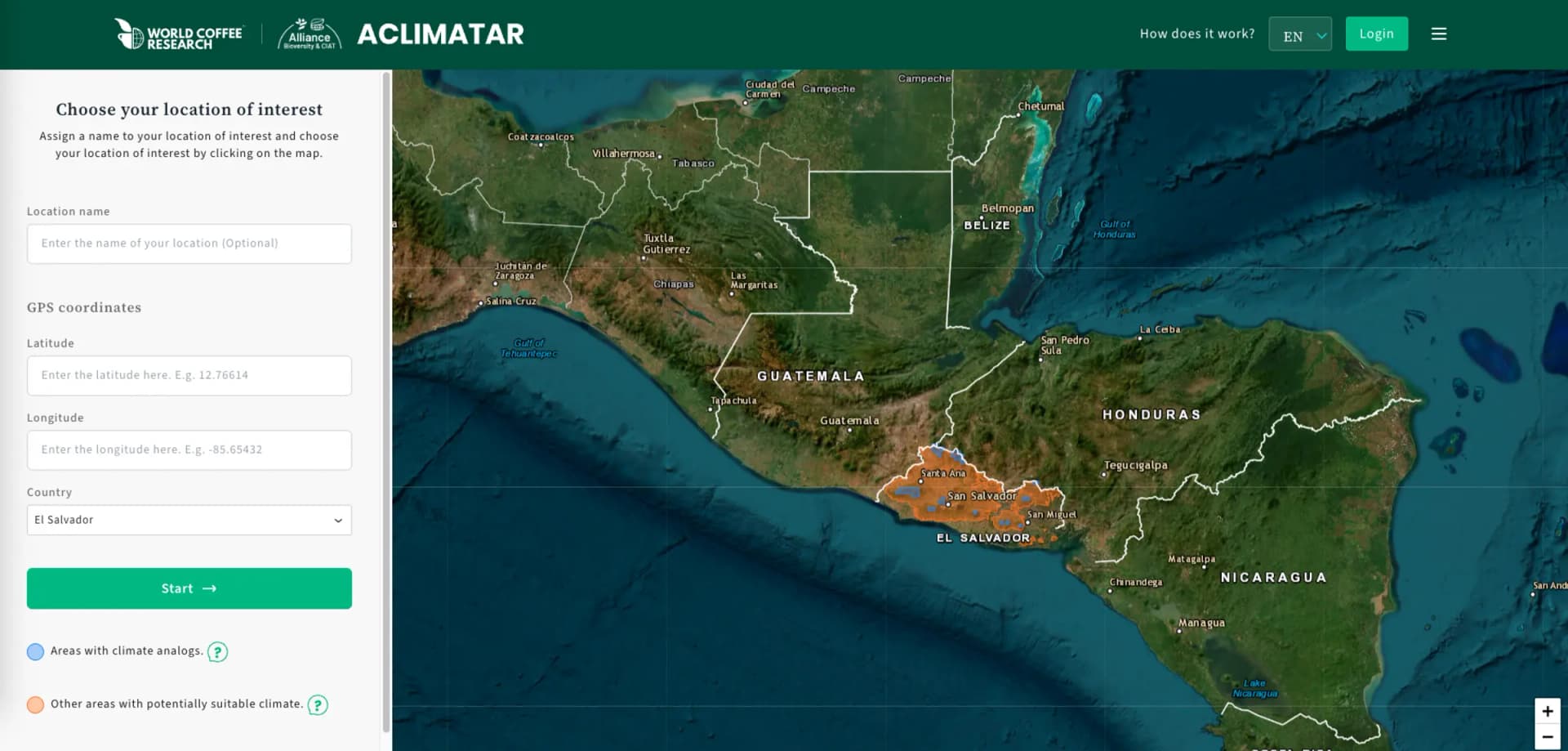
The platform, called CafeClima, was developed in partnership with the Alliance of Bioversity International and CIAT and is designed to help farmers, governments and investors decide which coffee varieties to plant as climate conditions shift. According to WCR, the tool integrates global performance data from coffee variety trials with advanced climate projections to support science-based renovation decisions.
- Aging Trees, Rising Risk
WCR says billions of coffee trees planted decades ago are now past peak productivity, contributing to production losses that intersect with climate shocks, pests and disease pressure. Replacing those trees is not optional, the organization argues — but doing so without climate insight could compound risk.
“A coffee tree planted today is a 20-year investment,” WCR CEO Dr. Jennifer “Vern” Long said in a statement. “The only thing more costly than inaction is action without insight.”
According to WCR, coffee trees on roughly 4 million hectares already require replacement to sustain current production levels — an area comparable to the combined coffee-growing footprint of major producers including Brazil, Vietnam, Colombia and Ethiopia.
- A $4 Billion Transition
The $4 billion figure referenced by WCR comes from a 2025 investment case by the international NGO TechnoServe, which estimates that transitioning to regenerative, climate-resilient coffee systems would require that level of investment over seven years.
WCR notes that governments and supply chain actors have invested an estimated $1.2 billion in renovation and rehabilitation efforts over the past two decades. However, those efforts have reached only about 5% of the world’s 11.5 million smallholder farmers who need new trees, according to the organization.
CafeClima is positioned as a tool to help de-risk this large-scale capital deployment by aligning renovation investments with climate science and field performance data.
- From Data to Decision
The platform draws on performance results from WCR’s International Multi-Location Variety Trial, a decade-long research effort conducted with national coffee institutes in 18 countries. The dataset includes 26 widely grown varieties tested across diverse climatic conditions.
By pairing that performance data with climate projections developed by the Alliance of Bioversity International and CIAT, CafeClima allows users to assess which varieties are more likely to succeed under projected future conditions.
One feature highlighted by WCR is the use of “climate analogs” — current locations that resemble the projected climate of another region decades into the future. This enables users to visualize not only where coffee may remain viable, but which specific varieties have demonstrated resilience under similar conditions.
The tool is available in English and Spanish and is intended for agronomists, sustainability managers, policymakers and development funders, as well as farmers making replanting decisions at smaller scale.
- A Shift Toward Predictive Planning
WCR describes CafeClima as part of a broader move from reactive, localized testing to predictive, globally informed planning in coffee production. Integrating climate modeling with breeding and field performance data, the organization says, is essential for perennial crops such as coffee, where varietal decisions shape farm outcomes for decades.
Development of the platform was supported by TechnoServe through funding from the United States Department of Agriculture, along with contributions from Taylors of Harrogate, Coffee Circle and more than 200 WCR member companies across 30 countries.
According to WCR, the goal is straightforward: ensure that billions of dollars expected to flow into coffee renovation over the coming years are invested in trees capable of withstanding tomorrow’s climate — not yesterday’s.