Author: Qahwa World – Agricultural Desk
Source: International Coffee Pest Monitor, USDA, and industry research (2025-2026)
Date: May 22, 2026In this article, we discuss Black Coffee Twig Borer pest control solutions and strategies for the coming seasons.
Executive Summary
- The Black Coffee Twig Borer (Xylosandrus compactus) is an invasive ambrosia beetle native to Southeast Asia, now damaging coffee in East Africa, Hawaii, and Latin America.
- It primarily attacks Robusta but also infests Arabica and over 200 host plants. Yield losses can reach 20-50% in severe infestations.
- Female beetles bore into small twigs, introduce ambrosia fungi, and cause branch dieback within 5-14 days.
- Factors favoring infestation: high planting density, poor pruning, water stress, and unsuitable shade trees (e.g., Maesopsis eminii).
- Integrated Pest Management (IPM) combines sanitation pruning, ethanol‑baited bottle traps, and maintaining tree health. Chemical control is a last resort.
- In Uganda, annual losses are estimated in tens of millions of dollars. Community‑wide trapping and pruning are the most effective.
- For growers in arid regions like the Gulf, prevention through certified pest‑free material and rigorous scouting is critical.
The Black Coffee Twig Borer (Xylosandrus compactus), also known as the shot‑hole borer, is a small ambrosia beetle native to Southeast Asia. It has become a significant invasive pest in many coffee‑growing regions, including East Africa (especially Uganda), Hawaii, parts of Latin America, and Southeast Asia.
It primarily affects Robusta coffee (Coffea canephora) but also attacks Arabica and over 200 other host plant species across 62 families. The beetle is considered one of the most economically damaging pests in affected areas, with reported losses reaching up to 20‑50% in severe infestations through branch dieback and reduced yields.
Biology and Life Cycle
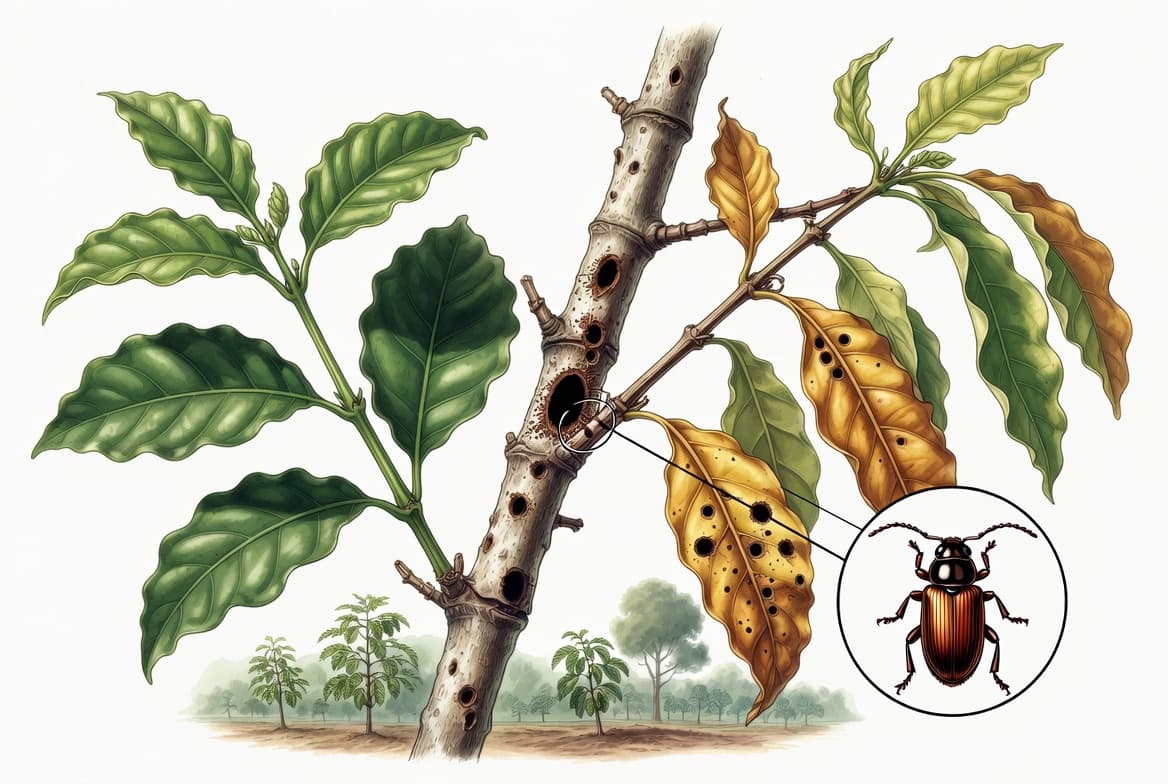
Adult females are 1.4–1.7 mm long, dark brown to black and shiny. Males are smaller (0.9–1.3 mm), flightless, and rarely seen outside galleries.
Only females initiate attacks. They bore into small twigs and branches (usually less than 2 cm in diameter) and introduce symbiotic ambrosia fungi (Raffaelea spp. or similar) that grow inside the tunnels and serve as food for adults and larvae.
The full life cycle takes about 3–5 weeks depending on temperature. Females mate inside the gallery (or via parthenogenesis) and lay eggs. Larvae feed on the fungus. New females emerge to attack other branches.
The pest attacks stressed, weakened, or overcrowded plants more aggressively, especially during dry seasons. However, it can also infest apparently healthy trees.
Symptoms and Damage on Coffee Trees
External signs include tiny circular entry holes (about 1 mm) on twigs, often with frass (sawdust‑like material) or sap oozing. Sudden wilting and yellowing of leaves on affected branches (flagging) appears within days. Dieback of twigs and small branches occurs within 5–14 days.
Internal damage involves fungal growth that blocks the xylem (water‑conducting tissues), causing rapid desiccation. Infested branches often show dark staining inside.
Economic impact is severe: loss of fruit‑bearing branches reduces yield directly. Repeated attacks weaken trees, increase susceptibility to other diseases, and can kill young plants or seedlings. In Uganda, annual losses have been estimated in tens of millions of US dollars. In other regions, branch loss can reach 20–40%.
Factors Favoring Infestation
High planting density and poor pruning (bushy canopies) create favorable conditions. Excessive or unsuitable shade trees, such as Maesopsis eminii (musizi) and Markhamia platycalyx (musambya), also increase risk. Water stress during dry periods, poor soil nutrition, and low tree vigor are additional factors. The presence of alternate hosts nearby further exacerbates the problem.
Integrated Pest Management (IPM) – Current Best Practices (2025-2026)
The most effective and sustainable approach combines cultural, mechanical, and monitoring methods. Chemical use is generally discouraged as a primary strategy.
Cultural practices form the foundation of control. Sanitation pruning is highly effective: regularly inspect and prune infested twigs or branches, then immediately burn or bury them deeply to prevent re‑infestation. However, it is labor‑intensive.
Tree health management is critical: ensure optimal fertilization, irrigation during dry spells, proper spacing (e.g., 3 m x 3 m), and balanced shade. Healthy, vigorous trees are far less susceptible.
Shade management involves using suitable shade trees (e.g., papaya may reduce infestation) and avoiding known host shade trees. Older, taller shade systems often show lower infestation levels. Remove or avoid planting nearby susceptible species.
Monitoring and mass trapping are highly recommended. Ethanol‑baited bottle traps are low‑cost and effective. Use empty plastic bottles with soapy water plus ethanol (or local alcohol like waragi at ~75% concentration) as attractant. Place 7–15 traps per acre, preferably in the lower canopy. Community‑wide trapping is most successful.
Chemical control should be a last resort. Systemic insecticides like imidacloprid (e.g., after pruning) have shown efficacy in some studies, but resistance risks and negative effects on beneficial insects limit long‑term use.
Emerging approaches include push‑pull strategies using repellents (e.g., verbenone + methyl salicylate) combined with attractant traps (2024 studies). Biological enhancement through biodiversity and natural enemies is also being explored.
Recommendations for Farmers (Particularly in UAE/Gulf Region)
Although Xylosandrus compactus is not yet widely reported in the UAE, vigilance is important if importing coffee plants or growing in similar climates. Source certified, pest‑free planting material. Maintain excellent tree nutrition and irrigation (critical in arid conditions).
Implement routine scouting, especially in dry or hot seasons. Adopt area‑wide management by coordinating with neighboring farms. Combine pruning, sanitation, and mass trapping as the core strategy.
Key principle: prevention through plant health is more effective and economical than curative measures.
Frequently Asked Questions
What is the Black Coffee Twig Borer?
It is an invasive ambrosia beetle (Xylosandrus compactus) that attacks coffee twigs, causing branch dieback and yield losses of 20-50%.
Which coffee varieties are most affected?
Robusta is the primary host, but Arabica and over 200 other plant species are also attacked.
How can I identify an infestation?
Look for tiny entry holes (1 mm) on twigs, sawdust‑like frass, sudden wilting of branches (flagging), and dieback within 5-14 days.
What is the most effective control method?
Sanitation pruning (removing and destroying infested branches) combined with ethanol‑baited bottle traps and maintaining tree health.
Are chemical insecticides recommended?
Only as a last resort. Imidacloprid has some efficacy, but resistance and environmental risks limit its use.
Can I use traps for mass trapping?
Yes. Ethanol‑baited bottle traps are low‑cost, simple to make, and highly effective when used community‑wide (7‑15 traps per acre).
Author: Qahwa World – Agricultural Desk | Source: International Coffee Pest Monitor, USDA, and industry research (2025-2026) | Date: May 22, 2026