Author: Ali Alzakary – Dubai. This article discusses the GCP public consultation Coffee SR Code 2026 and its relevance for stakeholders.
Event: GCP webinar, 19 May 2026
Source: Global Coffee Platform (GCP) public consultation launch materials and webinar
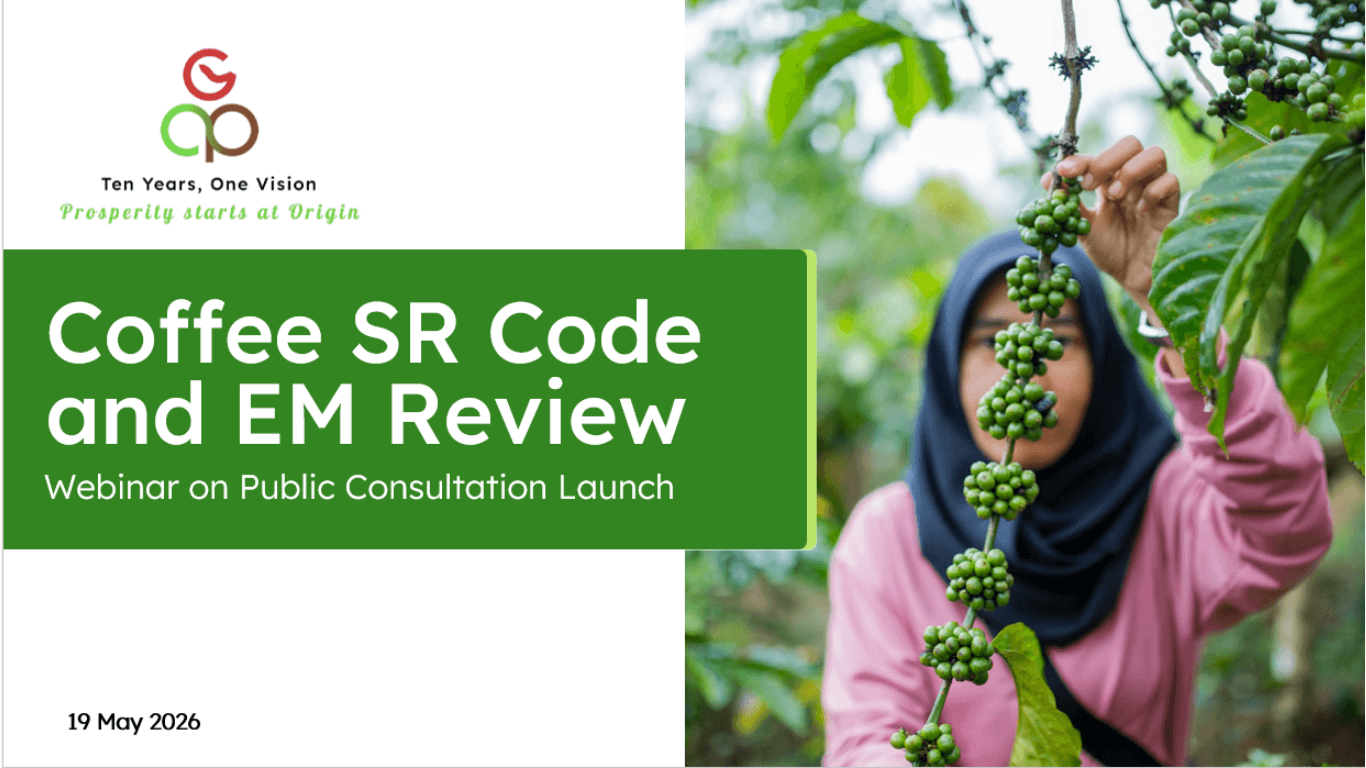
Dubai, 19 May 2026 — The Global Coffee Platform (GCP) today officially opened a 30‑day public consultation on the review of its Coffee Sustainability Reference Code (Coffee SR Code) and the Equivalence Mechanism (EM). The consultation, launched during a live webinar hosted by GCP Sustainable Sourcing Manager Gabriel Chavez, runs from 19 May to 19 June 2026 and invites stakeholders from across the coffee sector to help shape the next generation of these critical sustainability tools.
The Coffee SR Code was developed as a common language for baseline sustainable coffee production, centered on economic prosperity, social well‑being, and environmental stewardship. The Equivalence Mechanism recognises sustainability schemes that align with the Code, supporting comparability and mutual understanding across the sector. Both tools are being reviewed together to ensure coherence and continued relevance.
“We welcome the participation of stakeholders from across the coffee value chain and from around the world to bring their experience and expertise to this process,” said Gabriel Chavez, GCP Manager Sustainable Sourcing. “A rich diversity of voices will help ensure these tools are fit‑for‑purpose, modernised and relevant.”
Why the review matters now
The coffee sector faces increasingly complex challenges: climate change, evolving regulatory frameworks such as the EU Deforestation Regulation (EUDR), rising market expectations, and the need for greater alignment across sustainability initiatives. Since the tools were first launched, 33 schemes have been recognised under the Equivalence Mechanism (four third‑party and 29 second‑party). Sustainable coffee purchases recorded under GCP’s framework have grown from about 639,000 tonnes in 2018 to 1.73 million tonnes in 2024, according to data shared during the webinar.
“If we look at where we are now, there are no fewer than 33 schemes which are currently recognised under the equivalence mechanism,” said Jeremy Laforet, Chair of the GCP Technical Committee. “The purchases of sustainable coffee recorded have risen from about 639,000 tons in 2018 up to 1.73 million tons in 2024, which is a tremendous sign of the seriousness with which our industry takes coffee sustainability.”
The review follows GCP’s regular five‑year cycle, aligned with the ISEAL Code of Good Practice. The combined review of the Coffee SR Code and EM was mandated by the GCP Board to improve alignment across the sustainable sourcing approach and reduce stakeholder fatigue by avoiding separate parallel processes.
“Now it’s over to you, it’s over to the wider membership as a whole to ensure that these two tools – the SR Code and the equivalence mechanism – remain practical, relevant and credible.” – Jeremy Laforet, Chair, GCP Technical Committee
Key proposed updates
The review process has been informed by a comprehensive assessment phase that included 55 survey responses, 8 stakeholder interviews, two workshops with the International Trade Centre, and detailed analysis of 33 recognised schemes. The proposed updates focus on refinement rather than redesign.
For the Coffee SR Code, proposed highlights include a stronger emphasis on continuous improvement, maintaining a risk‑based and context‑driven approach, and reinforcing alignment with due diligence logic (risk assessment → action → monitoring). The Code remains positioned as a shared baseline for sustainable coffee, not a prescriptive certification standard.
For the Equivalence Mechanism, updates are more pronounced. They include improved clarity and structure, strengthened governance, transparency, and data integrity, clearer expectations on disclosure and accountability, and a reinforced risk‑ and due diligence‑based methodology that moves beyond “tick‑box” compliance.
“The overall approach of this review has been focused on refinement rather than redesign,” Chavez explained. “We are not aiming to fundamentally change the intent or the scope, but rather to strengthen and improve based on implementation experience, stakeholder feedback, and evolving sector expectations.”
How to participate
GCP has prepared a consultation toolkit available on its website. Stakeholders can access a summary of proposed changes (available in English, Spanish, Portuguese, Bahasa Indonesia, and Vietnamese), a full consultation draft of the Coffee SR Code (English only), and two online surveys.
The main survey consists of 25 required questions covering high‑level feedback and key substantive changes. It is available in English, Spanish, Portuguese, Bahasa Indonesia, and Vietnamese. A separate technical survey (English only) allows stakeholders to provide detailed, requirement‑specific input on individual requirements. Both surveys will remain open until 19 June 2026.
All responses are confidential and will be anonymised. A summary of consultation results will be published on the GCP website in the second half of July 2026.
Next steps
Following the public consultation, GCP will consolidate and analyse all stakeholder feedback, identify key themes, and develop revised drafts. These will go through further technical discussion and validation with the Technical Committee, the Advisory Task Force, and the GCP Board. The final updated tools are expected to be published by the end of 2026, together with clear implementation and transition pathways for scheme owners and users across the sector.