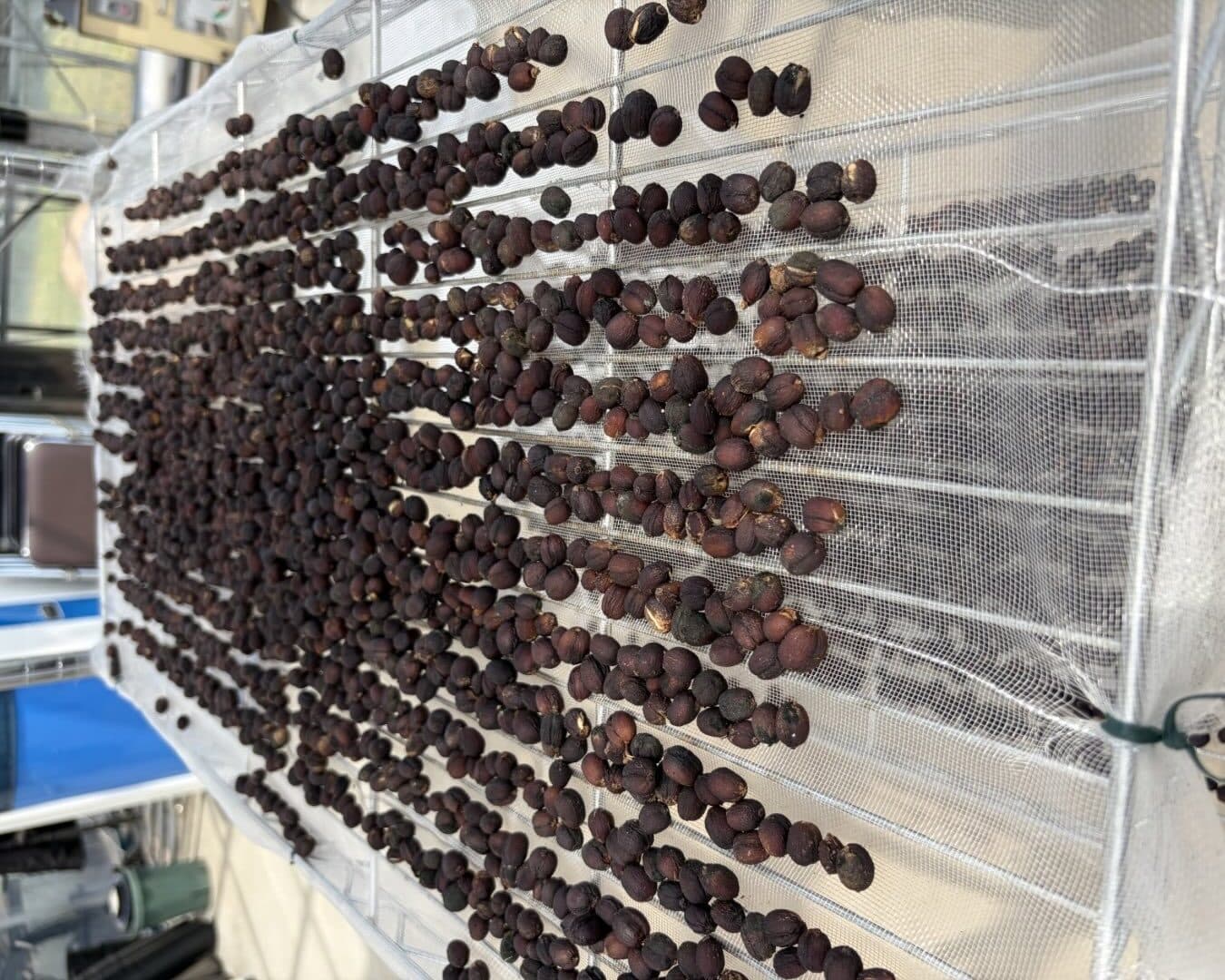
Source: Kanamori Coffee Lab visit and Nabeya Bi-tech company announcement
Date: May 21, 2026
- Nabeya Bi-tech, a Japanese manufacturing company founded in 1560, has launched Bitech Farm, a domestic coffee cultivation project in Gifu Prefecture.
- The farm operates a 700 square meter greenhouse with automated mist systems and 100 percent organic fertilizers.
- Approximately 120 to 150 coffee trees of Bourbon, Typica, and Mundo Novo varieties are under cultivation.
- The greenhouse environment supports simultaneous flowering, green cherry, and ripe cherry stages.
- First significant harvest is targeted for 2027, with full vertical integration planned from production to cafe sales.
- Kanamori Coffee Lab visited the farm and praised its long term commitment to quality and traceability.
- The project represents a rare serious greenhouse coffee effort on Japan’s main island of Honshu.
Nabeya Bi-tech, a historic Japanese manufacturing company founded in 1560 in Seki City, Gifu Prefecture, has diversified into agriculture with Bitech Farm, a domestic coffee cultivation project.
The company, which specializes in mechanical components such as couplings and precision screws, announced its Agri-Tech business in 2023. Inspired by a visit to vineyards in Mallorca, Spain, President Yujiro Okamoto launched coffee farming as a third technological pillar alongside traditional and new manufacturing.
The farm operates from a large vinyl greenhouse of approximately 700 square meters on the company’s factory grounds in Kakamigahara City. The facility uses automated mist systems for environmental control and relies on 100 percent organic fertilizers.
Smart agriculture technologies include self developed cloud based remote monitoring for data such as water temperature. The greenhouse creates a stable microclimate suitable for delicate coffee varieties, mitigating Japan’s seasonal temperature swings.
Coffee Varieties and Cultivation
| Attribute | Specification |
|---|---|
| Facility scale | Approximately 700 square meters (greenhouse) |
| Number of coffee trees | 120 to 150 trees |
| Coffee varieties | Bourbon, Typica, Mundo Novo |
| Fertilizers | 100 percent organic matter |
| Climate control | Automated mist systems and cloud based monitoring |
| Tree height | Up to 180 centimeters |
The farm primarily focuses on the Typica variety, an ancient high quality Arabica known for distinctive flavor, elegant sweetness, and clean acidity. Bourbon and Mundo Novo are also cultivated. A standout feature of the greenhouse ecosystem is the simultaneous presentation of multiple coffee phenological stages. Visitors can observe jasmine like white blossoms, young green cherries, and fully ripened red cherries all within the same space. The characteristic bronze to brown coloration of new shoots on Typica trees is vividly present, confirming that the cultivars maintain their genetic identity under Japanese conditions.
Vertical Integration and Traceability
Nabeya Bi-tech is building a rigorous vertically integrated business ecosystem. The model covers every link of the supply chain from seed to shrub cultivation, post harvest processing, product development, quality control, and final commercial sales. The company aims to market an ultra traceable, high value specialty coffee that deeply embraces the specific regional microclimates of Seki and Kakamigahara cities. The farm is situated just two and a half hours from Tokyo via high speed transit, making it an accessible hub for domestic roasting professionals, researchers, and green bean buyers.
The project started approximately five years ago. Seedlings were sourced painstakingly from Kumamoto after searches in Okinawa and Kyushu. Employees participated in a planting festival in 2025. The first significant harvest is targeted for 2027, with ambitions to eventually open a cafe. The company emphasizes terroir, traceability, and creating unique Japanese specialty coffee through on site processing including fermentation.
Kanamori Coffee Lab Visit
Kanamori Coffee Lab, a specialty coffee roaster based in Zama City, Kanagawa Prefecture, recently visited Bitech Farm. The lab is run by international coffee taster and Q Grader Fuki Kanamori. The visit left a strong impression of awe at the lush, tall trees and the full lifecycle visible in one space. The post highlighted the technical details of organic practices, automation, and variety traits. More deeply, the visitor resonated with the company’s mission, which is not merely about the novelty of rare domestic coffee, but a passionate long term commitment to quality, terroir understanding, and end to end traceability within Japan.
The response from the coffee community has been supportive. Industry voices note that the benchmark for the Japan coffee movement has shifted. The novelty of simply growing coffee beans in Japan is no longer enough. The focus has turned toward enhancing cup quality, experimenting with precise fermentation protocols, and accentuating local terroir. Nabeya Bi-tech’s data driven approach to environmental management positions it to be a key driver in defining premium domestic specialty coffee standards.
Frequently Asked Questions (FAQ)
1. What is Bitech Farm?
Bitech Farm is a domestic coffee cultivation project by Nabeya Bi-tech, a Japanese manufacturing company founded in 1560. It operates a greenhouse coffee farm in Kakamigahara City, Gifu Prefecture.
2. How many coffee trees are at Bitech Farm?
The farm has approximately 120 to 150 coffee trees of Bourbon, Typica, and Mundo Novo varieties.
3. What makes this coffee project unique?
It combines traditional Japanese manufacturing heritage with modern Agri-Tech, including automated mist systems, cloud based monitoring, and full vertical integration from cultivation to sales.
4. When will the first harvest be ready?
The first significant harvest is targeted for 2027. The project started approximately five years ago with planting in 2025.
5. Who visited the farm and what was their impression?
Kanamori Coffee Lab, a specialty coffee roaster, visited and expressed awe at the lush trees and full lifecycle in the greenhouse, praising the company’s long term commitment to quality and traceability.
6. Does the company plan to open a cafe?
Yes, the company has ambitions to eventually open a cafe as part of its vertical integration strategy from production to sales.
Published: May 21, 2026