Source: Sucafina 2025 Sustainability Report
Date: May 2026
Executive Summary:
- Sucafina achieved 43% of its sales as responsibly sourced or traceable to farm level in 2025.
- The company invested $7.42 million in training and community support projects.
- Coffee was sourced from 214,313 certified farmers worldwide.
- Sucafina monitored 437,602 plots across 18 countries for deforestation risk, with 99.2% deforestation-free.
- The company distributed 895,085 high-quality coffee seedlings and 203,748 native tree seedlings.
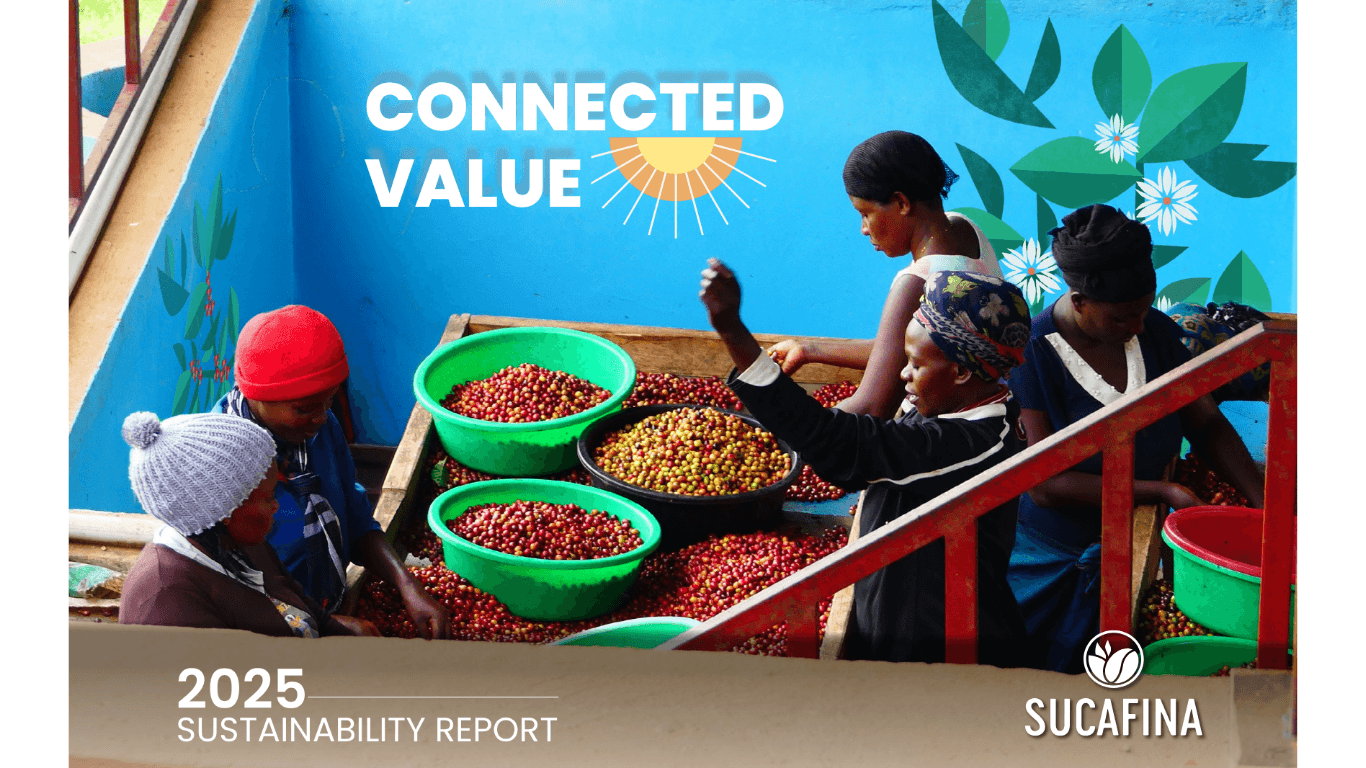
- Sucafina added “Accountability” as its seventh corporate value and adopted a “Connected Value” strategy.
- The company launched IMPACT Industrial to extend its responsible sourcing program to soluble coffee manufacturing.
Sucafina, a global leader in farm-to-roaster coffee trading, announced exceptional results in its 2025 annual sustainability report. The announcement came during a year marked by global uncertainty, rising costs, and evolving regulations. The company achieved record numbers in its IMPACT responsible sourcing program, raised its external investments in sustainability initiatives to unprecedented levels, and simplified its strategy while adding “Accountability” as its seventh corporate value.
Nicolas A. Tamari, CEO of Sucafina, said: “Despite a difficult start to 2025, the second half of the year revealed a more encouraging reality. We saw renewed commitment from customers who realized that sustainability, traceability, human rights, and environmental stewardship are not options.
They are integral to brand value and consumer trust. By the end of the year, we reached an important milestone: 43% of our sales were responsibly sourced or traceable to farm level. This is a strong signal that our long-term investments are aligning with market expectations.”
Key Sustainability Figures for 2025
| Indicator | Value |
|---|---|
| Certified farmers sourced from | 214,313 |
| High-quality coffee seedlings distributed | 895,085 |
| Farm plots monitored for deforestation | 437,602 (covering 674,161 hectares in 18 countries) |
| Deforestation-free plots | 99.2% |
| Native tree seedlings distributed | 203,748 |
| Farmers certified under IMPACT Verification | 69,229 |
| Total employee training hours | 11,971 |
| Investment in training and community projects | $7.42 million |
| Permanent employees trained in occupational health and safety | 680 |
| EcoVadis award | Bronze (top 35%) |
Strategic Update: Simplification, Integration, and Accountability
After five years of implementing its 2030 sustainability strategy, Sucafina conducted a comprehensive mid-term review. This resulted in an updated and simplified strategy centered on the concept of “Connected Value.” The five IMPACT program goals (Livelihoods, Regenerative Agriculture, Climate Action, Community Well-being, Forest Conservation) were integrated into three main pillars: Investing in Farmers, Caring for People, and Protecting the Planet. The company also added a seventh corporate value: Accountability, joining Adaptability, Humility, Entrepreneurship, Integrity, Expertise, and Passion.
In a strategic move, Sucafina decided to step away from the Science Based Targets initiative (SBTi) framework and transition toward a customized climate action pathway for its operations and supply chain.
The company will focus on practical interventions that achieve measurable emissions reductions and enhance resilience in coffee-producing regions, rather than compliance with a framework that does not always adapt to the reality of agricultural commodity trading.
Key Field Projects and Initiatives
Investing in Farmers
Sucafina’s Regenerative Agriculture methodology underwent external verification. It assesses the implementation of 15 targeted practices linked to four environmental dimensions: soil, water, biodiversity, and greenhouse gas emissions.
Pilot farms were established in Uganda and elsewhere. Notable projects include the SEMEIA project in Brazil (in partnership with Itochu and Ajinomoto AGF), a four-year initiative supporting nine farmers in Arabica and Robusta regions.
The project has planted 30,000 new coffee trees, installed composting units, and planted 6,680 native trees, aiming to reduce emissions and production costs by 2028.
Other initiatives include the Tools for Prosperity project in Uganda distributing basic agricultural tools, and the Regeneration Stimulation project in Rwanda (with 100WEEKS and Ahold Delhaize) where 95-97% of incentivized farmers performed radical pruning compared to 63% in the non-incentivized group.
Caring for People (Communities and Employees)
The REACH project in Uganda (with JDE Peet’s, Elucid, and RVO) developed a digital health financing platform serving 2,700 farming families, addressing challenges of treatment costs and distance.
Women’s savings and lending groups (VSLAs) were established in Burundi, Rwanda, and Kenya, along with support for livestock and beekeeping as additional income sources. For child protection, Sucafina joined the Child Rights Coalition in Uganda (with ChildFund, JDE Peet’s, Nestlé, NKG, Volcafe) to implement a system for monitoring and addressing child labor risks.
In education, the company built classrooms in Colombia (funded by 1% of Sucafina Instant’s net profits), supported early childhood programs in Guatemala with Seeds for Progress, and improved school facilities in Uganda.
Following Cyclone Sinar in Indonesia’s Gayo communities, Sucafina distributed emergency food packages to 913 farmers and 69 suppliers via two air freight shipments.
Protecting the Planet
For deforestation monitoring and EUDR compliance, Sucafina monitored 437,602 farm plots, with 99.2% deforestation-free.
The company developed an EUDR compliance methodology that includes geodata collection, satellite risk assessment, secondary verification, and support for environmental restoration efforts (including distribution of 203,748 native tree seedlings).
Solar energy was installed at the Beyers Koffie plant in Belgium: 642 high-efficiency solar panels (285.69 kWp capacity) produce approximately 243,000 kWh annually, covering 4-5% of the plant’s total electricity consumption.
In Rwanda, an agroforestry program in partnership with the London School of Economics distributed 110,064 regionally appropriate shade trees to 3,735 farmers with cash incentives for tree regeneration.
IMPACT Industrial: Extending the Program to Manufacturing
Sucafina unveiled a new track within its IMPACT program: IMPACT Industrial, designed to cover the production and manufacturing stages of soluble coffee.
The initiative aims to assess environmental, social, and governance practices among manufacturing partners and open constructive dialogue to improve performance in a stage that has historically lacked visibility and standardization.
Sucafina’s Operational Scale in 2025
| Indicator | Value |
|---|---|
| Permanent employees | 1,528 (38% women) |
| Seasonal employees | 7,138 (54% women) |
| Green coffee traded | 541,000 metric tons |
| Certified farmers sourced from | 214,313 |
| Market share | More than 1 in every 20 coffee cups consumed globally passes through Sucafina’s supply chains |
Frequently Asked Questions (FAQ)
1. What percentage of Sucafina’s sales were responsibly sourced in 2025?
43% of total sales were responsibly sourced or traceable to farm level.
2. How much did Sucafina invest in sustainability projects in 2025?
The company invested $7.42 million in training and community support projects through the Kahawatu Foundation and other initiatives.
3. What is the new corporate value added by Sucafina?
Sucafina added “Accountability” as its seventh corporate value, alongside Adaptability, Humility, Entrepreneurship, Integrity, Expertise, and Passion.
4. What is the new IMPACT Industrial track?
A new track within the IMPACT program designed to assess environmental, social, and governance practices among soluble coffee manufacturing partners and improve transparency in that stage.
5. How is Sucafina addressing EU Deforestation Regulation compliance?
The company developed a compliance methodology including geodata collection, satellite risk assessment, and secondary verification, resulting in 99.2% of monitored land being deforestation-free.
6. What are the goals of the SEMEIA project in Brazil?
The four-year project aims to reduce emissions and production costs by 2028 through new tree planting, composting units, and native tree cultivation.
Published: May 2026