The Swedish “Clinical Trial” Myth: Coffee vs. Tea. And the Winner Is…
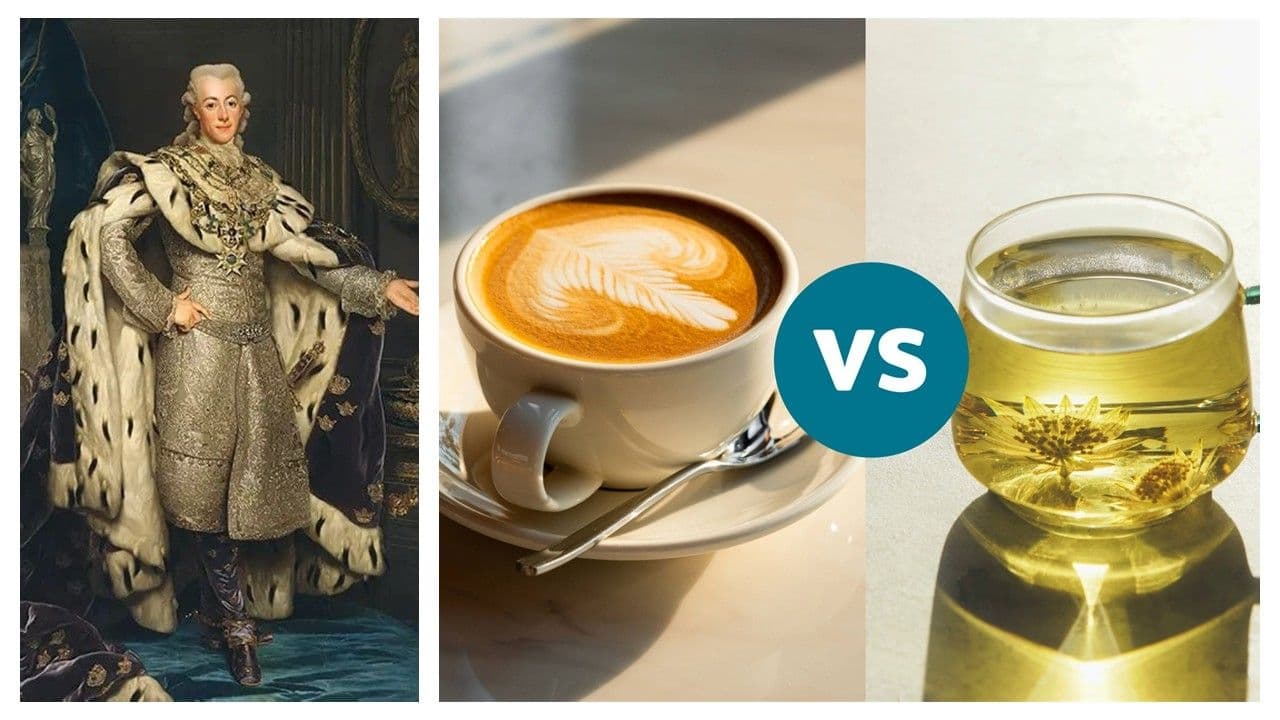
Legend has it that King Gustav III of Sweden (reigned 1771–1792) wanted to prove that coffee was harmful. According to the tale, he allegedly took two condemned identical twins, commuted their death sentences, and subjected them to a “scientific” experiment using extreme doses:
Twin A: three pots of coffee per day
Twin B: three pots of tea per day
Two physicians supposedly supervised the experiment and reported the results to the king. Ironically, the tea twin died first—at age 83 (!). Meanwhile, the king was assassinated before seeing the final outcome, and so coffee was declared the “winner.”
That’s the meme. But here’s the uncomfortable truth: the documentation is thin to nonexistent.
- The Historical Context
Sweden did have multiple periods of coffee restriction and prohibition. Coffee was considered a luxury import and a potential moral and economic threat. Enforcement created a lively underground coffee culture, with Stockholm police records documenting hundreds of cases involving illegal coffee selling, preparation, and consumption.
And yes, Gustav III is a real, well-documented historical figure.
But the specifics of the twin experiment raise many red flags:
No names of the twins
No prison identified
No surviving protocol
No contemporary debate traceable
It’s unusual for such a sensational “first clinical trial” to leave no trace. Even Uppsala University treats the story as unproven, explicitly noting:
“The truth of the story has not been proven.”

- Where the Story Likely Came From
The oldest description historians have located is not from the 18th century at all—it appeared in 1937, in Science News, via a claim that a museum curator found the experiment in 18th-century records.
This suggests that the story may be a 20th-century packaging of older anti-coffee sentiment, rather than a genuinely documented 18th-century experiment.
Yet, the anecdote is frequently retold in medical-history literature, often without primary evidence. Secondary sources can give the illusion of historical certainty, even when the original records are missing.
- Why the Myth Persists
The tale is irresistibly viral:
It dramatizes moral panic around coffee
It has a deliciously ironic twist: tea loses
It includes story candy: assassination, doctors, royal hubris
It flatters modern coffee lovers: “coffee was right all along”
All while piggybacking on a kernel of truth: Sweden really did restrict coffee and police its consumption.
Bottom line: The twin experiment is almost certainly a myth—but it’s a charming, cautionary story that shows how coffee culture, historical myth, and human imagination blend into one unforgettable anecdote.