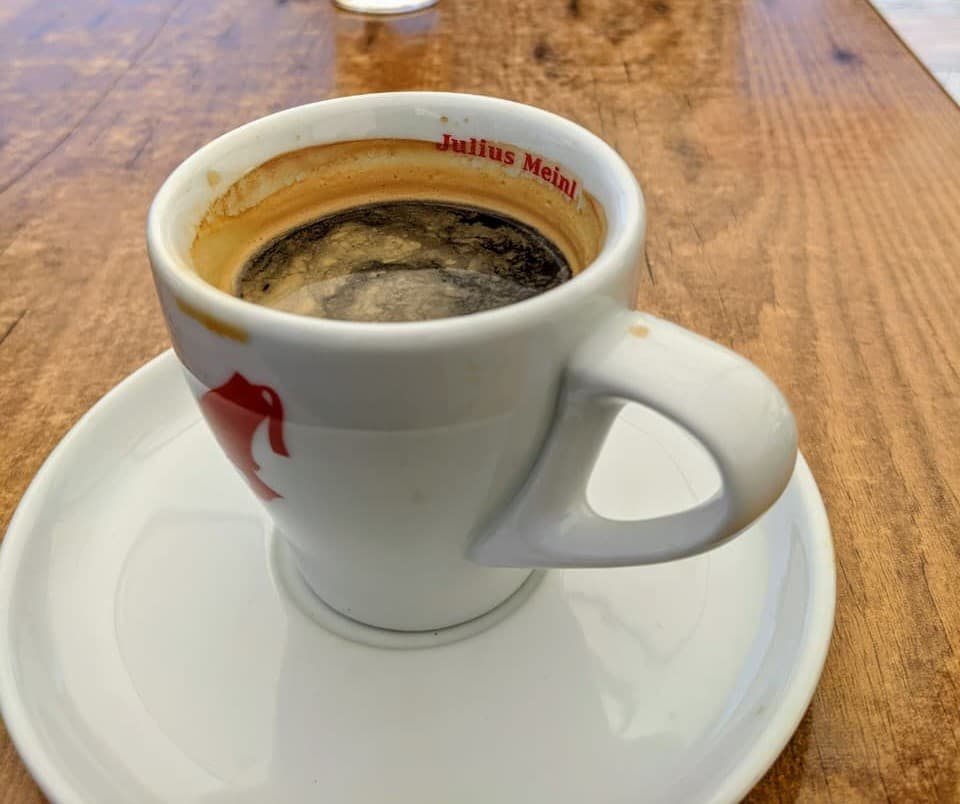
How flavour molecules, memory, and culture quietly rewrite the same espresso in the minds of experts and customers alike
Dr. Steffen Schwarz
There is a particular moment, just after the demitasse has been set down, when espresso becomes less a beverage than a negotiation between physics and expectation. The crema still holds its heat, volatile compounds are escaping in a plume too faint to see, and the taster is already reaching for words that feel solid enough to pin the experience to the table. In Seoul, an expert may lean in and say “clean, vibrant, floral”. In Milan, another expert might hesitate, then say “balanced, roasted, bitter but pleasant”. In Kansas, the verdict could be simply “good, consistent, nothing stands out”. The coffee, however, could be the same. The molecules certainly are. What changes is the sensory map in the brain, the vocabulary available to describe it, and the cultural training that decides which differences matter and which are politely ignored.
The modern coffee industry has learned to treat flavour as both currency and compass. We use it to price green coffee, to design roasts, to justify machinery investments, to position brands, and to reassure customers that what they loved yesterday will still be there tomorrow. Yet flavour is also the least stable part of our product, because it exists in two places at once: in the cup as chemistry, and in the customer as perception. The deeper difficulty is that the same chemical signals can be sorted into different meanings depending on what a person has learned to notice, what they have been rewarded for noticing, and which terms their community considers legitimate descriptors of quality.
A recent cross-cultural study of espresso evaluation makes this tension unusually visible. Rather than chasing ever more detailed chemical measurements, it asks a deceptively simple question: if we standardise the way we taste espresso, do experts in different countries describe it in the same way, and do they do so consistently over time?
The study used The Espresso Protocol (TEP), a structured sensory approach designed to quantify and communicate espresso characteristics efficiently and repeatably across panellists and geographies. Experts from France, India, Italy, the Republic of Korea, and the USA evaluated eight single-origin and blended coffees three times each, following a tightly specified preparation and tasting sequence that mirrors the temporal unfolding of espresso itself: crema first, then aroma, then flavour and mouthfeel, then basic tastes and aftertaste, and finally stability as the cup cools. This approach treats espresso not as a single snapshot, but as a moving target whose sensory profile evolves minute by minute as temperature drops, viscosity shifts, and different volatiles dominate the headspace.
The protocol also forces a confrontation with language. TEP uses a check-all-that-apply (CATA) structure rooted in established coffee lexicons, guiding tasters through categories such as fruity, floral, nutty, cereal, cocoa, sweet, earthy, roasted, spices, vegetative, stale/papery, chemical, and alcohol/fermented, with sub-terms that narrow each meaning. This is not bureaucracy; it is an attempt to standardise the bridge between sensation and communication. In commercial reality, that bridge is where much of coffee’s value is created or destroyed.
To understand why friction is inevitable, it helps to revisit what tasters are actually perceiving. Taste, physiologically, is limited to sweetness, sourness, bitterness, saltiness, and umami. What most people call “taste” in coffee is largely aroma, delivered retronasally. Espresso amplifies this effect: high-pressure extraction emulsifies oils, suspends colloids, and creates a dense aromatic matrix released in bursts as the liquid moves and warms the palate. The crema acts as a dynamic interface, trapping and releasing volatiles and shaping early versus later impressions.
The brain interprets these signals through memory. A descriptor such as “molasses” may be vivid to one taster and meaningless to another. “Black tea” may evoke different references depending on cultural background. Even “nutty” can mean peanut, hazelnut, or a general roasted-brown note. Without calibration, experts may not be disagreeing about the cup, but about what their words are allowed to mean.
This is why repeatability matters. If an expert cannot reproduce their own descriptions across repeated tastings, vocabulary becomes storytelling rather than measurement. Using cluster analysis of the CATA data, the study found that most experts were individually repeatable across evaluations. In the Republic of Korea, every expert showed strong internal consistency, while France and the USA were also high. India and Italy showed slightly lower but still substantial repeatability.
Repeatability, however, does not guarantee agreement. A homogeneity index revealed how similarly experts within each country used descriptors. Korea showed the highest homogeneity, followed by France, India, and the USA, with Italy notably lower. This likely reflects professional composition: Korean panels were largely baristas trained in contemporary speciality lexicons, while Italian panels included more roasters aligned with traditional espresso frameworks emphasising roast balance, bitterness, and texture.
This distinction matters. Sensory culture is not only national; it is professional. The daily decisions of a roaster, a barista, a green buyer, and a technician reward attention to different signals, shaping how flavour is perceived and described.
Quality scoring revealed further nuance. Ethiopian samples were rated highest across most countries, while older, pre-packaged samples scored lowest, suggesting that freshness and aromatic vitality transcend culture. Beyond these anchors, rankings diverged. The USA panel compressed scores, while Italy and Korea used a wider range. This does not imply weaker discrimination, but different scoring cultures. Some environments train restraint; others reward differentiation. Since scores influence price, these cultural tendencies carry real economic consequences.
Customers, meanwhile, rarely speak in lexicon terms, yet their preferences arise from the same mechanisms: familiarity, learned associations, and cultural expectations of what “good coffee” should be. Preference is memory-driven. The palate does not only detect; it predicts.
For decision-makers, this creates a paradox. We want flavour language stable enough to support operations, yet flexible enough to speak to diverse markets. The solution is not to eliminate subjectivity, but to design systems that acknowledge and manage it.
Preparation is the first control point. Small changes in espresso variables radically reshape the cup. Brewing standards and water specifications are therefore foundational to comparability. Roast choice adds another layer: roast is itself a cultural translation of green coffee potential.
The second control point is lexicon training. Differences in terminology across cultures highlight the need for shared sensory education. This is not about enforcing uniformity, but about preventing costly misunderstandings. Words must function as instruments, not ornaments.
The third control point is aligning expert language with consumer perception. Tools like TEP can bridge expert evaluation and market reality by producing repeatable descriptive data that can be correlated with consumer liking and willingness to pay. Whether consumers themselves can meaningfully engage with such protocols remains an open and commercially significant question.
At the chemical level, flavour compounds arrive unlabeled. The same chemistry can be framed as “bright” or “sour”, “complex” or “fermented”, “roasty” or “burnt”, depending on context. Preferences evolve with exposure, fashion, and cultural narratives. No system is inherently right; each is coherent within its own aesthetic logic.
The strategic insight is simple: words are part of the product. Flavour is interpreted as much as it is extracted. Language shapes perception, guiding what tasters and customers search for in the cup. The responsibility of the industry is to ground that language in repeatable sensory reality while remaining aware of its cultural flexibility.
Espresso is a time-based experience. Quality is not a point, but a curve. Protocols like TEP attempt to measure that curve and give it language. This research shows that experts can do so consistently across countries, yet always through cultural lenses. For managers aligning sourcing, roasting, training, and marketing, this is not a limitation—it is an invitation to treat sensory strategy with the same rigour as logistics or engineering.
Because once the demitasse hits the table, the science of perception will happen anyway—whether we have prepared for it or not.