At the same time, climate change remains the most significant long-term challenge facing the sector. Across producing regions, erratic weather patterns—from prolonged droughts to unexpected rainfall and extreme storms—disrupt harvest cycles, reduce yields, and create growing uncertainty throughout the global coffee value chain.
Despite this challenging environment, EFICO achieved strategic growth in 2025, moving more coffee than ever while continuing to build on nearly a century of experience in connecting coffee value chain partners. Through strategic sourcing and transparent collaboration with partner farmers, cooperatives, exporters, and roasters, EFICO works to strengthen every link in the chain—helping partners navigate market volatility, regulatory complexity, and climate-related challenges.
EFICO | Connecting the coffee value chain
For nearly a century, EFICO has connected coffee value chain partners through long-term, trusted relationships that foster resilience and shared growth. Through its origin offices and green coffee trading teams, EFICO works closely with partner farmers, cooperatives, and exporters, providing market access, technical guidance, and sustainability support while maintaining lasting partnerships with partner roasters worldwide.
Complementing its operational sourcing work, the EFICO Foundation supports coffee-producing communities worldwide—structurally supporting coffee farmers and their families while positively impacting livelihoods, prosperity, and the environment.
Purpose-driven local partnerships
EFICO’s sourcing strategy is built on purpose-driven partnerships across the coffee value chain, starting at origin. By collaborating closely with cooperatives, local exporters, and trusted supply partners, EFICO works to ensure a transparent and resilient coffee supply while reinvesting value locally in coffee-producing regions.
In 2025, 85% of EFICO’s coffee continued to be sourced from local actors, reflecting the company’s long-standing commitment to locally rooted supply chains. Within this share, cooperatives represented 23% of total sourcing volumes, while local exporters accounted for 57%, showing a slight shift compared to 2024. International exporters remained stable at 15% for the third consecutive year.
These long-term partnerships support local economies, strengthen farming communities, and reinforce resilience throughout the broader coffee value chain—particularly in times of market volatility and environmental uncertainty.
EFICO’s sourcing offices in Ethiopia, Central America, and Brazil remain central to this strategy. Beyond operational hubs, they serve as centers of adaptive collaboration, connecting EFICO directly to coffee-growing regions. By working closely with partner farmers, cooperatives, and suppliers on the ground, these origin offices help partner farmers navigate fluctuating market conditions, climate challenges, and evolving regulatory requirements, while strengthening relationships with partner roasters worldwide.
Certified, verified vs non-verified coffee
In 2025, EFICO recorded remarkable growth in absolute terms, with certified volumes increasing by 34% compared to last year, while shares among Rainforest Alliance, Fairtrade, and Organic remained stable, reflecting continued commitment to certifications.
Rainforest Alliance held the largest share at 64%, also leading in absolute growth, while Fairtrade and Organic recorded the largest relative growth, recovering from the decline observed in 2024 as premiums increased and market prices remained high.
A shift in origins was observed, with a lower share of Organic and Fairtrade sourced from Central America in favour of Latin America, Africa, and Asia.
However, overall coffee sourcing volumes increased even faster than certified volumes. As a result, the relative share of certified and verified coffee represented 49% of total sourcing—marking the third consecutive year of modest relative decrease.
Despite this shift, EFICO’s sourcing remains above the global market average, as reported by the Global Coffee Platform in 2024, which registered 47% sustainable sourcing under third-party schemes.
These dynamics reflect broader market conditions. During periods of high and volatile coffee prices, certification models can become more complex for both producers and buyers, as certification costs and administrative requirements must be balanced against market opportunities.
Strategic sourcing: key origins
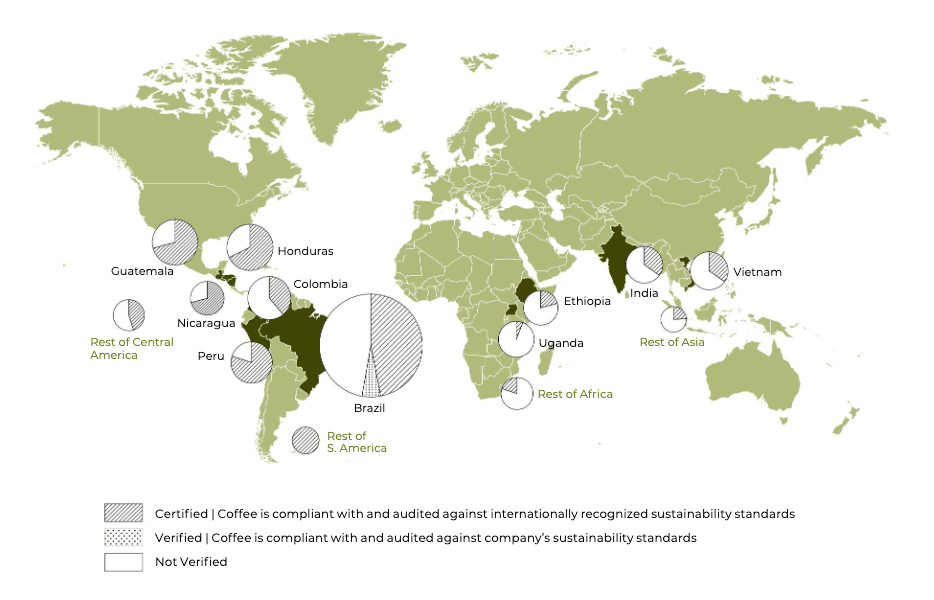
The world map provides a 2025 snapshot of coffee origins, showing the shares of certified, verified, and non-verified coffee. These patterns vary across EFICO’s key coffee-producing regions, reflecting differences in sourcing volumes, certifications, and partnerships.
For a more detailed view, EFICO analysed sourcing data from its major origins—Brazil, Central America, and Ethiopia—and included Uganda as a key Robusta origin without a permanent EFICO office.
Brazil
Brazil remained EFICO’s largest sourcing origin in 2025, accounting for approximately one-third of total sourcing volumes. The country continues to provide high-quality Arabica coffees that form an essential component of both blends and single-origin offerings.
In 2025, 47% of EFICO’s Brazilian sourcing was certified. An additional 17% was verified under EFICO’s internal sustainability standards, including 6% independently verified and 11% aligned with partner-based sustainability systems. This brings the total share meeting certification or verification criteria to 64%.
At the same time, 85% of Brazilian coffee volumes were sourced from local actors, reinforcing EFICO’s long-standing commitment to strong local partnerships.
While certified volumes increased in absolute terms, the relative share of certified coffee declined slightly as conventional volumes expanded more rapidly amid strong market demand.
Central America
Central America remained one of EFICO’s most important regions for certified sourcing in 2025. 66% of coffees sourced from the region were certified, with Rainforest Alliance representing the largest share and showing the strongest growth.
Fairtrade sourcing also showed steady growth during the year, while Organic-certified coffees declined both in absolute volumes and relative share.
This trend reflects a combination of market dynamics and regulatory developments: high and volatile coffee prices influenced producer and buyer decisions, while the increasing complexity of complying with updated EU organic requirements made sourcing fully compliant Organic coffees more challenging in some producing countries.
Across the region, 79% of EFICO’s sourcing came from local actors, reinforcing long-standing partnerships with cooperatives and exporters.
Through the ongoing work of the EFICO Foundation, EFICO supports projects that promote training and education, sustainable income, infrastructure support with the aim of positively impacting coffee farmers’ livelihoods, prosperity, and environment.
Ethiopia
Ethiopia experienced significant growth in sourcing volumes in 2025, with total volumes more than doubling compared to the previous year. While much of this increase occurred in conventional coffees, certified volumes also expanded.
In total, 21% of Ethiopian coffees sourced by EFICO were certified, with an additional 19% meeting EFICO’s internal sustainability standards, bringing the total share aligned with sustainability criteria to 40%.
Local partnerships remain central to EFICO’s sourcing approach in Ethiopia, with 80% of volumes sourced from local actors.
A key partner in this development is KURU, EFICO’s long-standing sourcing partner in Ethiopia, which expanded its operations to eight washing and collecting stations in 2025—four more than in 2024.
This expansion strengthens processing capacity and traceability while reinforcing EFICO’s direct connection to coffee-producing communities.
Uganda
Uganda is included in this 2025 analysis because sourcing volumes from the country have grown significantly, making it a strategic addition to EFICO’s Robusta portfolio.
Within just two years, Uganda has become EFICO’s third-most important origin for Robusta coffee, even though sourcing remains predominantly conventional.
79% of Ugandan volumes were sourced from local actors, highlighting EFICO’s commitment to building sustainable, locally rooted supply relationships, even in regions without a permanent origin office.
EUDR readiness & supplier engagement
In 2025, EFICO continued its efforts to ensure compliance with the EU Deforestation Regulation, despite the late announcement of another one-year delay in its entry into application.
By the end of the year, 93% of geolocation datasets submitted for EUDR contracts were approved according to EFICO’s strictest standards and assessments.
A major step was the launch of EFICO’s supplier portal, improving data collection, traceability, segregation at shipment level, and annual legality reporting, including topics such as human rights and traceability.
Togo field engagement
Togo was selected for focused engagement to support suppliers less familiar with geolocation and traceability requirements.
Since early 2024, EFICO has trained local field teams to collect, harmonise, and validate farmer and plot-level data. Over 2025, nearly 10,000 GPS points were collected.
A second field visit in December 2025 implemented ground truthing procedures to verify deforestation alerts and assess multi-tier supply chains.
Most coffee plots are managed under agroforestry systems. Satellite-based alerts initially identified potential deforestation risks, but field verification ruled out most cases, confirming only a few instances linked to expansion into previously forested land.
Non-compliant plots were segregated within EFICO’s traceability systems, while farmers received training on deforestation prevention and sustainable land-use alternatives.