DUBAI – ALI ALZAKARY
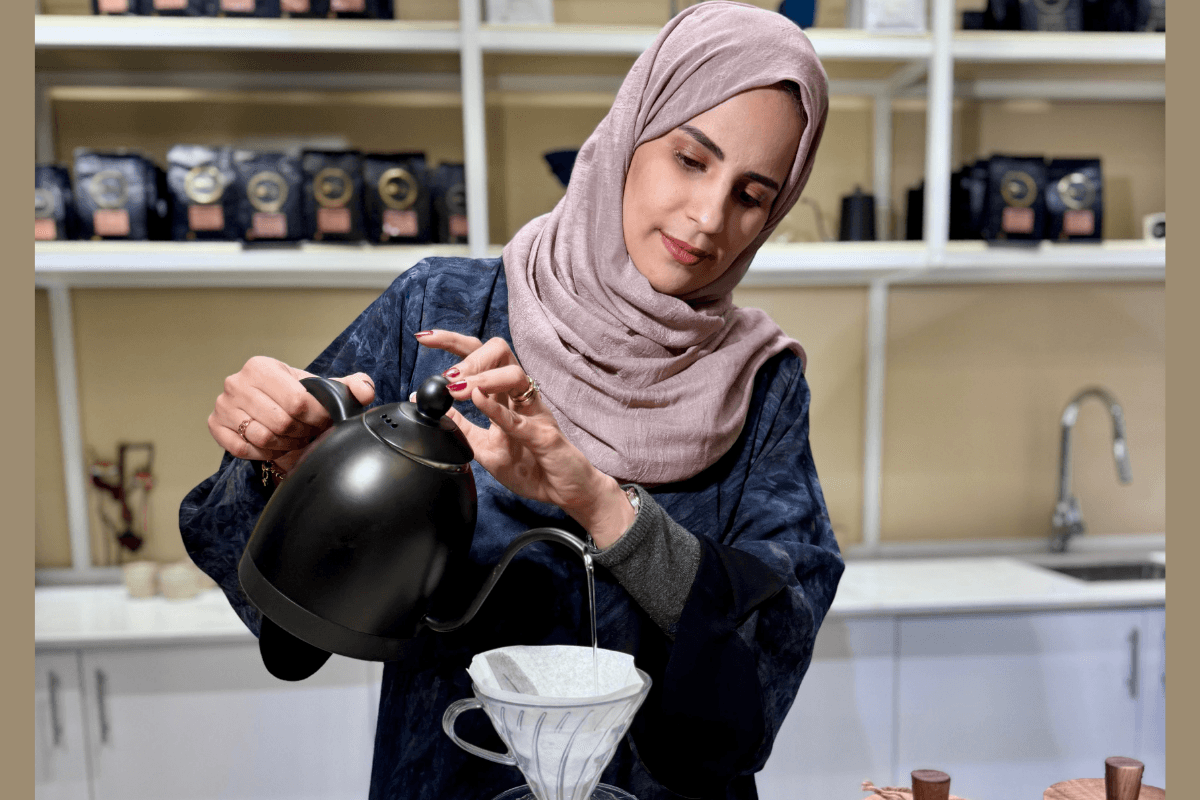
From the ancient streets of Sana’a, where tradition meets modern ambition, comes the story of Hind Shaia, a pioneering entrepreneur and content creator. Her project, “Nawah,” is more than just a café; it is a tribute to Yemen’s rich heritage and a bridge to the global specialty coffee market. By blending historical authenticity with international quality standards, Hind is proving that Yemeni coffee remains a world-class treasure. We invite you to explore this inspiring journey through our exclusive interview, where we discuss the future of the industry and the role of women in shaping its success.
- Hind, when did your journey with Yemeni coffee begin, and what first drew you to it?
I wasn’t originally a coffee enthusiast. In 2015, my journey began out of a need for focus and energy during work and studies. Over time, this search turned into a real passion. By 2016, I began to dive deeper into the world of coffee and started drinking it regularly. Whenever I traveled, I made sure to visit specialty cafes and explore crops from different nations. However, Yemeni coffee remained the standard I used for comparison. I discovered that its character was truly different; its flavors are complex and deep, providing a balanced focus without anxiety.
- How did you decide to establish “Nawah” and share Yemeni coffee with the world?
The decision matured in stages. The idea began as a dream in 2021, but I hesitated due to job security. However, my confidence in Yemeni coffee’s potential pushed me to invest. In 2024, my husband and I launched Nawah as an online store to raise awareness about specialty coffee. In early 2026, the dream became a reality with the opening of Nawah Café in Sana’a, a space that offers a modern and sophisticated image of our coffee.
- Coffee in Yemen is more than just a drink; how would you describe its role in daily culture?
It is a part of our identity and history. From the mountain terraces and the port of Al-Makha, this drink reached the world. In our culture, every part of the fruit is used—from “Qishr” to roasted coffee. While its status declined slightly as tea became a cheaper alternative, there is a “return of awareness” today, especially among the youth who care about quality and history.
- Yemeni coffee has a global reputation; what do you think makes it so special?
The uniqueness comes from a mix of land, people, and history. Yemen produces high-quality Arabica. The geography is crucial, as coffee grows at high altitudes between 1,800 and 2,400 meters. This slow ripening process highlights natural sweetness and complex flavors, offering notes of fruit, chocolate, and spices.
- How has the coffee industry in Yemen changed recently? Are there new modern touches?
The industry now combines tradition with modern standards. Farmers still pick cherries by hand, but new processing methods have been introduced, such as using raised drying beds and modern machinery for sorting by size and color. Despite this, the human touch remains vital in final hand-sorting to ensure quality.
- How do you see the relationship between traditional farmers and the specialty coffee industry?
It is a partnership. The farmer is the “guardian of the treasure.” Our role is to bridge the gap between the farm and the cup by introducing modern processing knowledge. When a farmer sees that attention to detail doubles the crop’s price, they become a partner in quality, ensuring sustainability and fair returns.

- How do you see the future of Yemeni coffee in local and global markets?
Our role is “excellence and rarity,” not mass production. We don’t compete in volume but in exceptional quality. Yemeni coffee is repositioning itself as a luxury product for connoisseurs. Globally, our historical legacy is a powerful marketing tool for specialty coffee.
- What are the main opportunities to expand the presence of Yemeni coffee abroad?
First, telling the “story,” as the world buys an experience. Second, e-commerce, which facilitates direct access to global roasters. Third, participating in international exhibitions to reach the market that appreciates the true value of Yemeni coffee.
- What is the role of women in the coffee industry today, especially in Yemen?
Their role is fundamental. Women are present from planting to the final cup. In rural areas, they participate in picking and sorting. Today, this role has evolved into leadership; we see Yemeni women certified as experts in tasting (SCA) and running their own export companies.
- As a café owner in Sana’a, what were the biggest challenges you faced?
The biggest challenge is the general economic situation and limited purchasing power. We received many warnings about the timing, but our faith in quality was our driver. There are also logistical challenges in transporting coffee from rugged mountains and importing equipment.
- What are the most important lessons you’ve learned in management and quality?
The first lesson is that consistency is the real challenge; maintaining standards daily is harder than just opening. Second, customers buy an experience. At Nawah, we educate visitors about the coffee’s story so they become ambassadors for Yemeni coffee.
- Despite the current situation, how do you see the future of exporting Yemeni coffee?
While we cannot deny the export difficulties and restrictions, the spirit of trade is in our blood. We find solutions to overcome obstacles. We still export Yemeni coffee worldwide, and the supply chain remains resilient due to the determination of those in the sector.