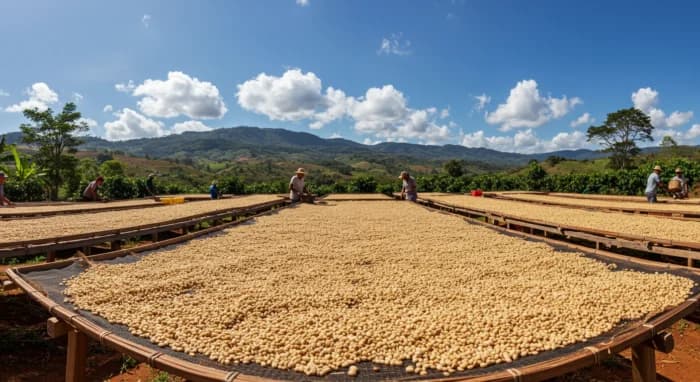
Coffee is cheap. Despite rising retail prices over the past few years, it remains affordable for the bulk of consumers in the Global North. Because coffee is inexpensive, we drink a lot of it—more than two billion cups every day, worldwide.
It’s all too easy to take coffee for granted. Instead of seeing it as an agricultural commodity—one that takes significant resources, and immense labour, to grow, harvest, process, transport, roast, and brew—consumers are more likely to think of their morning coffee as a basic staple.
The fact that so few coffee drinkers are cognisant of these complexities is by design. The price of coffee is typically kept as low as possible for the end consumer, but that doesn’t mean the industry doesn’t have costs, whether monetary, environmental, or social. It’s just that they’ve been displaced onto someone else—in this case, farmers and workers in producing countries.
The coffee industry has operated according to these lopsided power dynamics since colonial times, when rich nations in Europe extracted wealth and raw materials from their subjugated dominions. Today, many countries in the Global South are still reliant on exporting cash crops and raw materials to the Global North, often importing the finished goods at a higher price.
As Fidel Castro put it in a famous 1953 speech, “We export sugar to import candy, we export hides to import shoes, we export iron to import plows”.
This exemplifies unequal exchange, a Marxist economic theory coined by Arghiri Emmanuel in 1972 which posits that rich countries in the Global North are able to grow their economies and prosper by keeping more of the value of trade with the Global South.
Instant Coffee and Global Value Chains
Take instant coffee as an example. Large multinational companies source the cheapest possible beans, process them in industrial facilities, and sell the final product at a significant markup.
Often, the same producing countries that grow the beans later import the finished product.
These dynamics extend beyond trade. Environmental costs are also shifted along the chain.
Since the 1970s, neoliberal “green development” policies encouraged farmers to intensify production, clearing shade trees to increase yield.
The result: cheaper coffee for consumers, but stagnant income and rising ecological damage in producing regions.
World Systems and Structural Inequality
World Systems Theory, developed by Immanuel Wallerstein, describes the global economy as a structure divided into core, semi-periphery, and periphery countries.
Coffee fits neatly into this model: production is concentrated in the periphery, while profit-heavy processing and branding remain in the core.
The Green Transformation of Coffee
From the 1970s onward, coffee farming shifted dramatically due to disease pressures like coffee leaf rust.
Shade-grown systems were replaced with sun-grown monocultures using chemical inputs and high-yield varieties.
While production increased, environmental costs rose sharply—deforestation, biodiversity loss, and water stress became widespread.
Labour and Invisible Value
Despite being the foundation of global coffee production, farmers often receive only a small fraction of the final retail price.
Research from Eastern Uganda shows that producers may earn only a few cents per cup sold in the Global North.
In many cases, women contribute significant labour but receive even less due to unequal control over income distribution.
Conclusion: A System Under Pressure
The global coffee market is shaped by competing forces: rising demand, climate instability, and consumer resistance to price increases.
Within this system, costs are not eliminated—they are redistributed.
By Fionn Pooler
Qahwa World