Author: Qahwa World × Buna Kurs |
Photographer: Buna Kurs & Inter American Coffee |
Date: June 7, 2026
The Mountain Knows: Running and Coffee at 2,400 Metres Above Addis Ababa
Key Takeaways:
- Ethiopia gave the world both coffee and legendary distance runners. Both thrive at altitude.
- The Entoto Park CBE Run happens on the first Saturday of every month – 5km, free, no prizes.
- Haile Gebreselassie, the greatest distance runner, now grows coffee in the Sheka forest under his own name.
- The Ethiopian coffee ceremony and long-distance running share the same wisdom: patience, surrender, respect for time.
- At 2,400 metres, the air asks something of you. Runners and coffee cherries both mature slower – and better – at altitude.
- This is not a race. It is a monthly community ritual: coffee, eucalyptus, and a mountain that knows what it means to show up.
On a Saturday morning in Addis Ababa, at 2,400 metres above sea level, somewhere between a cup of coffee and a finish line, I think I understood something about Ethiopia that no guidebook had managed to explain.
The bus from 6 Kilo area leaves at 6:30 in the morning and it is already full. Not full in the polite, managed way of a shuttle service — full in the way Addis Ababa is full of things: pressing, warm, alive with conversation in three languages at once. Someone has brought a thermos. The eucalyptus smell hits before the park gates do, that particular green-grey sharpness that belongs to Entoto and nowhere else. By the time we are winding up the hillside road in the half-dark, I notice that nobody on this bus is anxious. There is no pre-race tension of the kind I know from European starting pens. People are laughing. An older woman in a white compression sock and a bright yellow headband is asleep against the window. A teenager is filming a reel of the trees. It is June 6th, the first Saturday of the month, and we are going to run.
What Entoto Asks of You
Entoto Natural Park sits on the northern rim of Addis Ababa at somewhere between 2,400 and 3,000 metres. The city sprawls below it; the sky above it feels closer than it should. The air is genuinely different up here — not thin in the gasping, dramatic way of high-altitude mountaineering literature, but thin in a way you only notice a few minutes into exertion, when your lungs quietly inform you that the usual arrangement is not going to apply today.
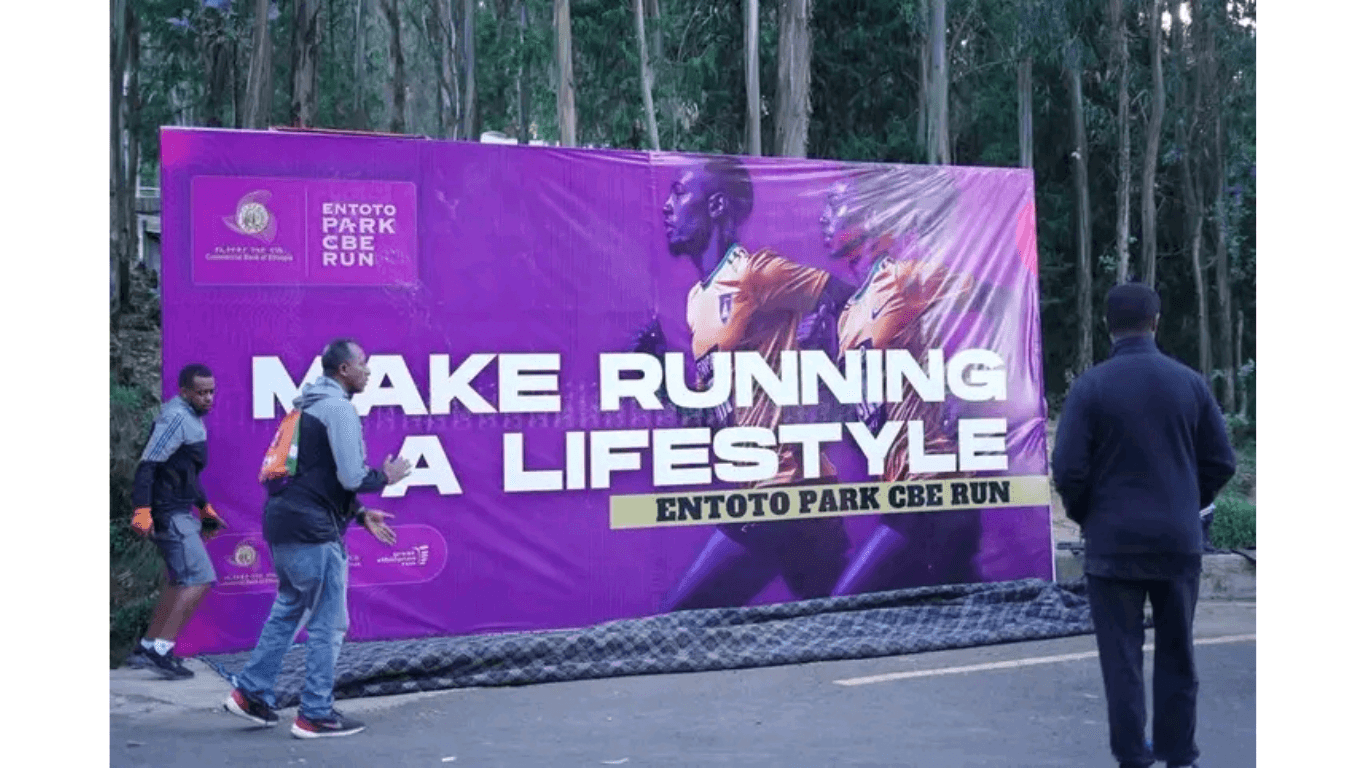
The Entoto Park CBE Run has been going since late 2024, organized under the Great Ethiopian Run umbrella, supported by the Commercial Bank of Ethiopia’s CBE Birr Plus platform, and held on the first Saturday of every month. Five kilometres. Free entrance. Capped at 700 runners. Registration opens at 6 AM on the last Monday of the month and fills, reliably, fast.
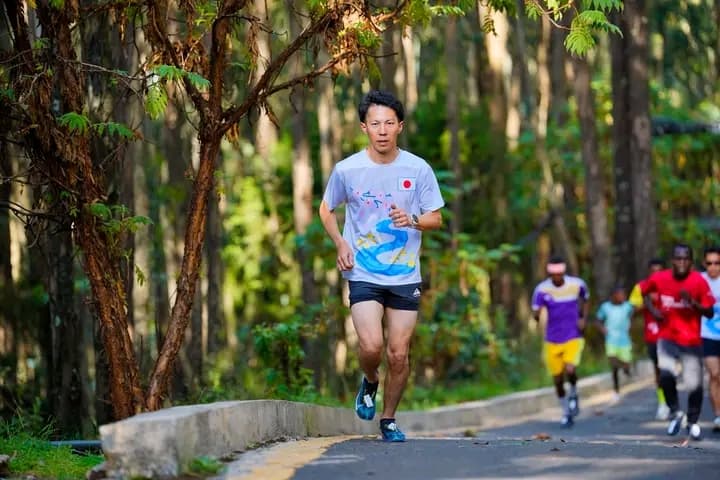
The course is a masterpiece of honest cruelty. The organizers have named each kilometre after a bird — a decision that sounds whimsical until you are running it and realize the names are doing real descriptive work. Uphill, then descent, then a flat middle, then the steepest climb, then a final swoop to the finish. Five kilometres. Five birds. Five completely different conversations between your body and the road. Running the fourth kilometre this morning — steep asphalt between tall eucalyptus, the city somewhere invisible below — I found myself thinking about what it means to be built for something difficult. About whether the difficulty is the point.
A Crowd That Does Not Perform
There is a photograph I keep coming back to from this morning. Hundreds of people, hands raised, Ethiopian flags threading through the crowd, the Addis Ababa Tourism Commission banner marking the edge of the frame. The eucalyptus trees are tall and pale behind them. Everyone is mid-motion, mid-joy. What strikes me is that nobody is performing for the camera. This is not a branded moment — or rather, it is branded, the purple of the Commercial Bank’s CBE Run signage is everywhere — but the joy inside the frame is not manufactured. These are people who woke up early and got on a bus and came to a mountain to run five kilometres together, and they are visibly, plainly happy about it.
At Entoto this morning, the DJ was already playing when we arrived. Someone handed me a coffee — I will come back to the coffee — and I stood at the start area and thought: this is what running looks like when it has not been turned into content yet.
The Man Who Built This
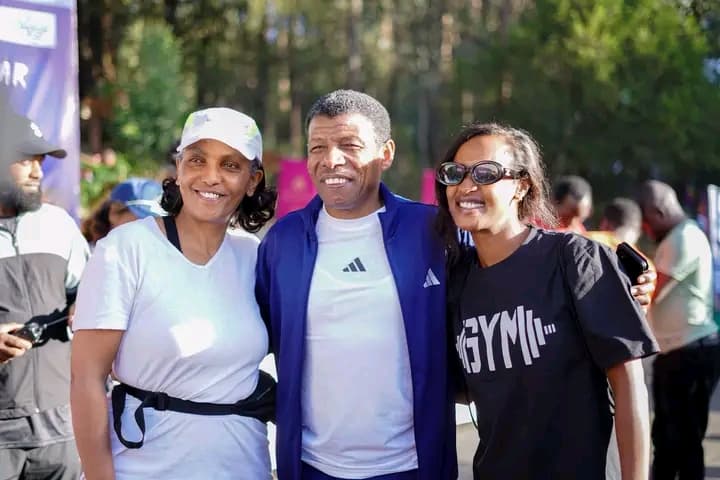
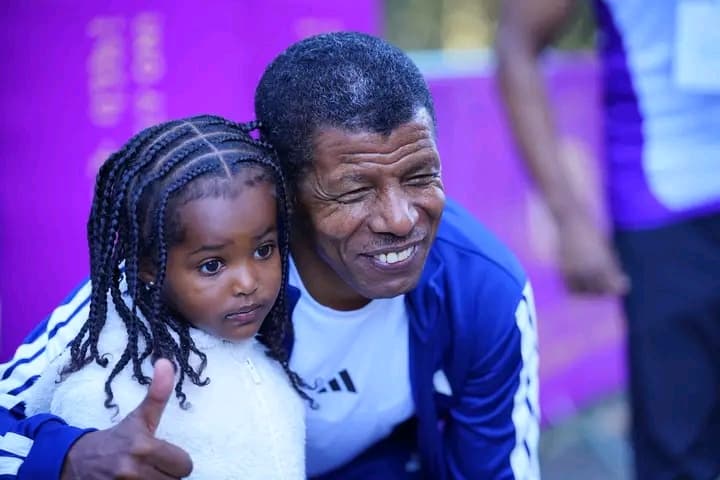
Haile Gebreselassie is 51 years old and was at Entoto this morning. Two Olympic gold medals, four World Championship titles, 27 world records across distances from 1,500 metres to the marathon. He held the marathon world record for years. The Amharic messages circulating in the lead-up to today’s run included the line: ሀይሌ በእንጦጦ አብሮን አለ — Haile is with us at Entoto. Not WILL BE. IS. Present tense. As if his presence is already a fact of the mountain.
But what I find more interesting than the records is what Haile has done with the decades since them. He founded the Great Ethiopian Run in 2001, which has grown into the largest road race in Africa, with over 40,000 participants annually. He runs an annual Girls Run race in Addis, specifically to create space for young women. And he has built the Entoto Park CBE Run into something that functions as a monthly community ritual rather than a competitive event — there are no prizes for winners. No prizes for winners. Think about what that signals, especially under the banner of a man who spent his career winning things. It says: this run is not about hierarchy. It is about showing up.
The Cup Before the Gun
The Entoto Park CBE Run offers complimentary coffee before and after the race. This is listed in the race day services alongside the baggage area and the DJ set. It is not an afterthought or a sponsor activation. It is infrastructure. I drank mine standing at the edge of the starting area, in that specific quality of early Addis light — not yet warm, the eucalyptus still holding onto the night’s cold — and I thought about something I had been turning over for weeks. Ethiopia is the country that gave the world coffee. Coffea arabica is indigenous to the highlands of Ethiopia. Ethiopia also, with some consistency, gives the world its fastest distance runners. Two things — coffee and running — that the rest of the world imports from Ethiopia. Both growing at altitude. Both demanding patience and the willingness to suffer usefully. And now, on a mountain above Addis Ababa, being served one alongside the other, before 700 people go out into the eucalyptus together.
Haile’s Other Harvest
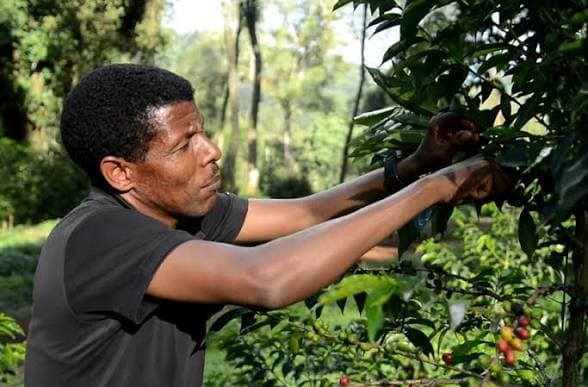
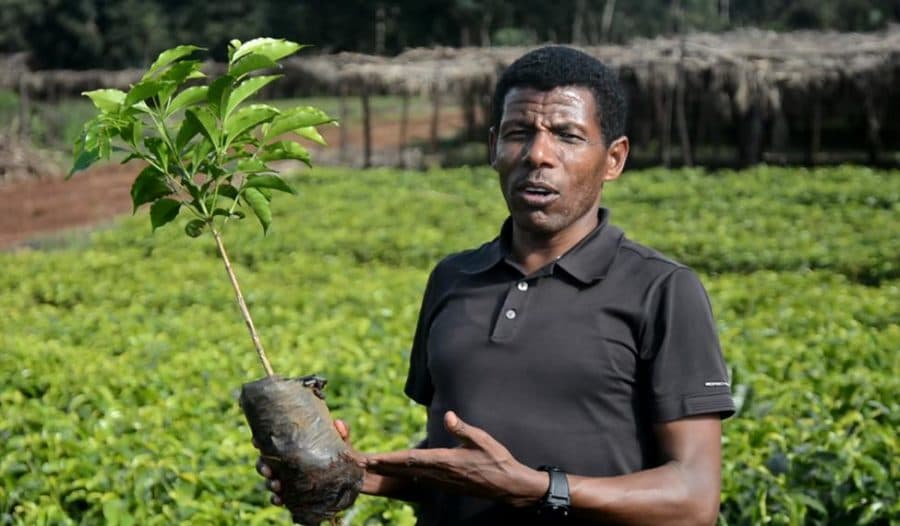
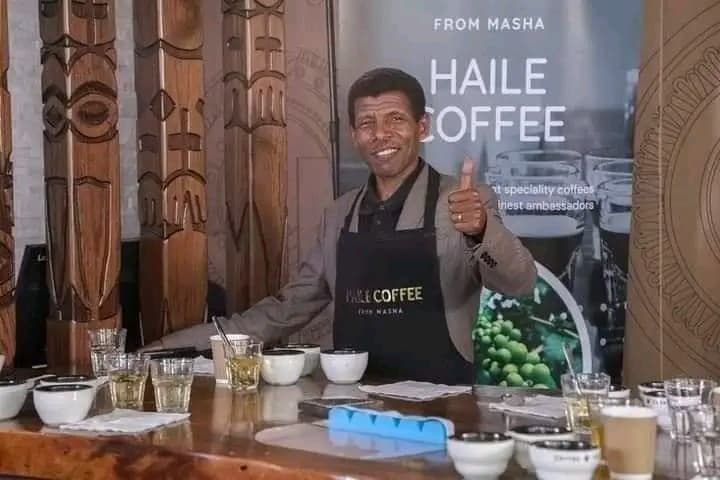
In 2014, Haile Gebreselassie became a coffee farmer. The Ethiopian government gave him 1,500 hectares of land in Yeppo Village, in the Sheka forests of southwestern Ethiopia. He transformed it into a coffee estate. The Sheka forest sits at 1,600 to 1,800 metres, within a zone recognized by UNESCO as a biosphere reserve. The farm is divided into more than 50 identifiable plots, each with specific varieties and processing methods. Washed and natural, and this year for the first time, honey processed. The coffee is called Haile Coffee. What I find moving about the enterprise is what Haile has said about it: “Coffee is such a big part of the culture in Ethiopia. We Ethiopians have a unique opportunity to share our culture with people around the world.” And then, characteristically, he reached for the language of athletics: “You need three things to win. Discipline, hard work and commitment. No one will make it without those three.” He is describing coffee farming the way he describes marathon training. The patience required to tend a coffee estate is the same patience required to run a 2:03 marathon. You cannot shortcut either.
What the Ceremony Knows That the Race Does Not
The Ethiopian coffee ceremony — bunna maflat — takes the better part of an hour. The green beans are washed and roasted over charcoal, slowly, until the smoke carries their particular smell. They are ground by hand. The coffee is brewed in a clay jebena and served in small handle-less cups. Three rounds: abol, tona, baraka. The third, baraka, means blessing. You cannot rush this. Long-distance running, done properly, operates on the same principle. Runners who go out too fast in the first kilometre pay for it in the fourth and fifth. The body has its own timeline and it will be respected. Both traditions encode this wisdom in ritual. The ceremony says: sit down, the coffee will take as long as it takes. The race says: start slow, find your rhythm, let the road come to you. These are the same instruction in different forms.
The Mountain This Morning
The first kilometre was uphill, lungs adjusting, the city falling away behind you faster than you would expect. The eucalyptus are planted in long rows and the light comes through them in columns. There is no sound except breathing and footfall. The second kilometre, descending, was where I remembered why I run. The fourth kilometre nearly broke me. At 2,400 metres, steep uphill deep into a run that already has climbing in its legs, is a genuine negotiation between your will and your physiology. And then the final descent. The finish line. Afterward I had another coffee.
Why This Matters – For Both Worlds
If you are a coffee person: Ethiopia is not just an origin. It is the place where coffee is understood as a practice, a social technology, a form of time kept together. The bunna ceremony is not a tourist experience — it is how Ethiopians structure hospitality and community. If you are a runner: the Entoto Park CBE Run is what community running looks like when it is not organized primarily as content. No prizes. A DJ. Complimentary coffee. 700 people on a mountain. And if you belong to both worlds simultaneously: there is something almost embarrassingly perfect about standing at a starting line at altitude in the country that invented coffee, holding a cup of coffee, about to run through a forest, before a legend who decided that the same discipline, hard work, and commitment that made him a champion could grow a great cup of coffee in a UNESCO biosphere reserve.
Baraka
The third cup in the Ethiopian coffee ceremony is the blessing. By the time I drank mine today — standing near the finish line, the race over, the crowd dispersing slowly into the eucalyptus morning — the Entoto light had changed completely. I thought about Haile on his farm in Sheka, applying to coffee the same three things he applied to running: discipline, hard work, commitment. I thought about altitude — how it shapes coffee cherries by slowing their maturation, concentrating their sugars and acids into something more complex. How it shapes runners’ bodies by demanding more of their cardiovascular systems. How Entoto, right now, on the first Saturday of every month, is doing both things simultaneously — maturing runners slowly, in the thin air, at 2,400 metres, into something more than they were at the start line. The coffee was good. The run was hard. Neither needed to be anything else.
Event information: The Entoto Park CBE Run takes place on the first Saturday of every month in Entoto Natural Park, Addis Ababa. Registration opens at 6:00 AM on the last Monday of the month via CBE Birr Plus. Transport from 6 Kilo from 6:30 AM. Free entrance. Complimentary coffee included. Haile Coffee is available internationally at haile.coffee.
Coverage by Qahwa World × Buna Kurs – Addis Ababa. Photography by Buna Kurs and Inter American Coffee.
All rights reserved. Republication with attribution permitted.
Publication date: June 7, 2026
Gallery