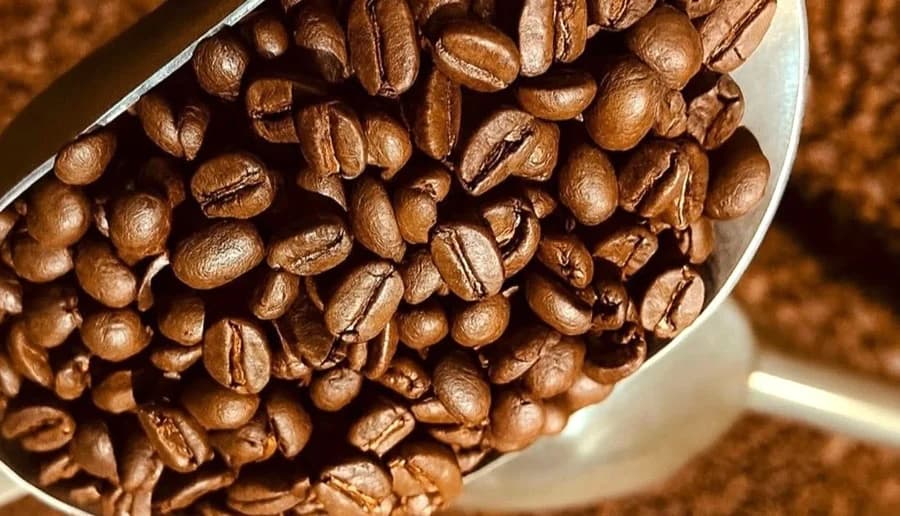
Global coffee prices moved higher for a second consecutive session as bargain buying emerged after recent six-month lows. While Brazil and Vietnam are expected to expand production, tightening exports and shifting inventories are keeping the market balanced.
DUBAI – QAHWA WORLD
Global coffee markets extended gains for a second consecutive session on Friday, supported by renewed buying interest after prices recently fell to six-month lows.
March arabica futures (KCH26) closed up 0.40 cents (+0.13%), while March ICE robusta (RMH26) rose by $24 (+0.63%), with robusta touching a one-week high. The rebound follows a sharp two-week decline that pushed both contracts to six-month lows earlier in the week, encouraging roasters to rebuild inventories at more attractive price levels.
- Domestic Market Remains Stable
While international prices moved higher, domestic coffee prices held steady at 96,400–97,700 VND per kilogram. The highest levels were recorded in Gia Lai and Dak Lak at 97,700 VND/kg, while Lam Dong posted the lowest at 96,400 VND/kg.
On the futures markets, London robusta contracts advanced across delivery months. The January 2026 contract rose by $24 to $3,859 per ton, and the November 2026 contract gained $46 to $3,584 per ton.
In New York, March 2026 arabica edged up 0.4 cents to 300.05 cents per pound, while the December 2026 contract climbed 0.85 cents to 286.40 cents per pound. Brazilian arabica futures showed mixed movement, with March down 4.6 cents to 384.0 cents per pound and May up 1.35 cents to 381.4 cents per pound.
- Pressure from Expanding Supply
Despite the short-term recovery, coffee prices have faced sustained pressure from expectations of strong global supply.
Brazil’s crop forecasting agency, Conab, projected that Brazil’s 2026 coffee production will rise 17.2% year-on-year to a record 66.2 million bags, including a 23.2% increase in arabica output to 44.1 million bags and a 6.3% rise in robusta production to 22.1 million bags.
YOU MAY LIKE: High Coffee Costs Force Americans to Change Their Daily Habits
Improved weather conditions have further eased supply concerns. According to Somar Meteorologia, Brazil’s key arabica-growing region of Minas Gerais received 72.6 mm of rainfall in the week ended February 6 — 113% of the historical average — reducing earlier drought worries.
Vietnam’s strong export performance has also weighed on robusta prices. The country’s National Statistics Office reported January coffee exports surged 38.3% year-on-year to 198,000 metric tons, while full-year 2025 exports rose 17.5% to 1.58 million metric tons. Vietnam’s 2025/26 coffee production is projected to increase 6% year-on-year to 1.76 million metric tons (29.4 million bags), marking a four-year high.
- Inventory Recovery Adds Headwinds
The rebound in ICE-monitored inventories has also added downward pressure. Arabica stocks, after falling to a 1.75-year low of 396,513 bags in November, recovered to a 3.25-month high of 461,829 bags in early January. Robusta inventories similarly rebounded from a 13-month low in December to a two-month high by late January.
- Supportive Factors Remain
On the supportive side, Brazil’s January coffee exports dropped 42.4% year-on-year to 141,000 metric tons, tightening short-term supply availability.
In Colombia, the world’s second-largest arabica producer, January coffee production fell 34% year-on-year to 893,000 bags, according to the National Federation of Coffee Growers.
The International Coffee Organization (ICO) reported that global coffee exports for the current October–September marketing year declined 0.3% year-on-year to 138.658 million bags, pointing to tighter trade flows.
Meanwhile, the USDA Foreign Agriculture Service (FAS) projected world coffee production in 2025/26 will increase 2.0% year-on-year to a record 178.848 million bags. Arabica output is expected to fall 4.7% to 95.515 million bags, while robusta production is forecast to rise 10.9% to 83.333 million bags. FAS estimates 2025/26 ending stocks will decline 5.4% to 20.148 million bags from 21.307 million bags in 2024/25.
- Market Outlook
The market remains caught between short-term demand recovery and longer-term supply expansion. While bargain buying has lifted prices in recent sessions, forecasts for larger crops in Brazil and Vietnam continue to cap upside momentum.