By: Ennio Cantergiani – Académie du Café
Specialty coffee professionals know the moment well: a Rwanda or Burundi coffee expected to showcase vibrant stone fruit notes suddenly reveals the unmistakable flavor of raw potato. This phenomenon, known as the Potato Taste Defect (PTD), affects not only flavor but also the livelihoods of farmers and the economics of the coffee trade.
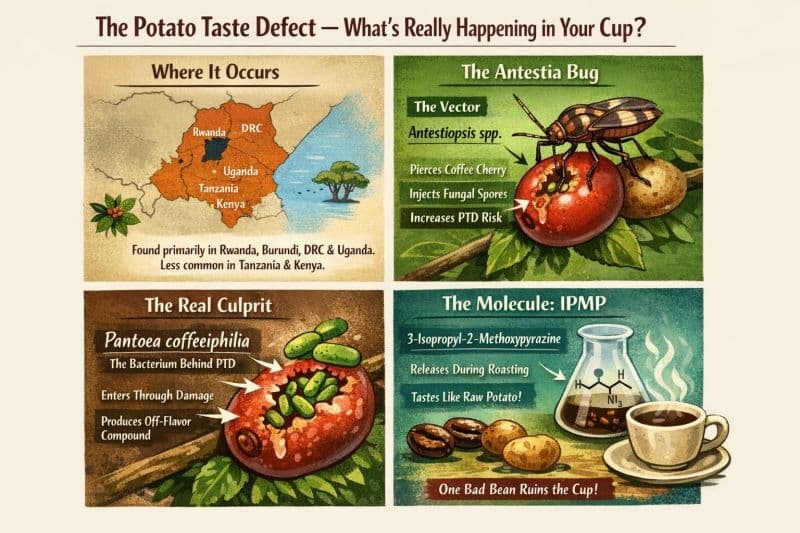
PTD is most commonly found in Rwanda, Burundi, the Democratic Republic of Congo, and Uganda, with occasional cases in Tanzania and Kenya. Researchers first documented it in eastern DRC, and its biochemical mechanisms continue to be investigated.
The defect is often linked to the Antestia bug, which pierces coffee cherries, injecting saliva and fungal spores. While the bug increases the risk of PTD, it is not the direct cause. The true culprit is the bacterium Pantoea coffeiphila, which colonizes damaged cherries. This bacterium produces compounds — IPMP and IBMP — that volatilize only during roasting, resulting in the raw potato, earthy, and starchy flavors that appear in the cup. Even a single affected bean can spoil an entire brew.
Read Also: Coffee Carbon Footprint: How Sustainable Is Your Cup?
Beyond taste, PTD has economic consequences. Studies indicate the defect can reduce the price of high-quality coffee by up to 57%, and buyers often penalize entire origins, lowering prices for lots that may contain no defective beans. For farmers who rely on coffee as their primary income, this structural challenge is significant.
Preventing PTD requires care across the supply chain. On farms, removing leftover fruit, pruning trees, and targeted use of natural insecticides reduce risk. Wet mills can use flotation, visual sorting, and technologies such as UV or laser scanning to detect damaged beans. Roasters and baristas should cup multiple samples, grind smaller test batches, and purge equipment if PTD is detected, remembering that the defect is sporadic, not systemic.
PTD is not a reason to avoid coffees from Rwanda, Burundi, or DRC. Instead, it is a reason to know the origins and producers deeply. With knowledge and careful handling, the distinctive, high-quality flavors of the Great Lakes region can still shine in every cup.