Is This Good News or Bad News?
By Ennio Cantergiani
Owner and Managing Director, L’Académie du Café – Switzerland
For more than twenty years, we have treated a single number as the ultimate truth about coffee quality.
86.25 vs. 87.00 — as if the second coffee were objectively better.
But in sensory science, a score is not a truth. It is a measurement. And every measurement comes with uncertainty, which is almost never communicated.
In sensory science, we use statistics to validate hypotheses. Multiple measurements allow us to calculate an average, a median, and a standard deviation. A score without a standard deviation says nothing.
- Why the “One-Score” Model Is Reaching Its Limits
1. Reliability Is Often Weaker Than We Admit
Different cuppers, different contexts, different expectations — different numbers.
This is not about “bad cuppers.” It is the nature of human perception:
Anchoring effects (the first sample sets the scale)
Contrast effects (coffee A changes how coffee B is perceived)
Semantic bias (words shape perception)
Fatigue and sensory adaptation
Calibration and alignment drift over time
When the measurement error is larger than the difference you are pricing, the number becomes fragile.
2. We Confuse Measurement with Value
A single score blends multiple dimensions:
Sensory performance (what is in the cup)
Preference (what I like)
Market narratives (what is trendy)
Rarity and social proof (what wins competitions)
Then we pretend this mixture represents one objective axis.
It does not.
- 3. Scores Influence Money at Origin — Sometimes Unfairly
This is where it becomes uncomfortable.
When price is strongly tied to a number, producers are pushed to optimize for the scoring system, not necessarily for:
Long-term agronomy
Risk management
Climate resilience
Local sensory identity
Realistic processing constraints
- What Comes Next (and Why It’s Better)
We will not stop evaluating coffee quality. But we should stop pretending that a single number is the best way to do it.
- The future looks like:
Multi-dimensional assessment (descriptive, affective, and functional)
Confidence ranges, not fake precision (e.g., 86 ± 1)
Clear sensory evidence with traceable data (digital tools and better training loops)
Fit-for-purpose grading (espresso vs. filter vs. blends vs. cold brew)
Contracts combining specifications and sensory profiles, instead of worshipping one score
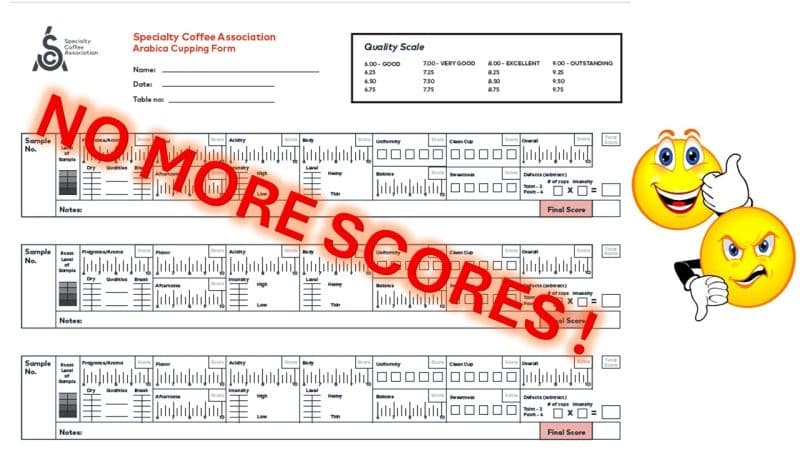
The score will not disappear overnight, but its monopoly will. No one will continue teaching the 2004 Q form indefinitely.
Will CVA replace the scoring system? Probably — but we need one to two years of feedback from major industry players. It will also need adaptation to better reflect the reality of coffee trading.
And honestly, that would be healthier — for producers, traders, roasters, and for sensory science.
- A Question for the Industry
If tomorrow we removed the 100-point score, what would you use to trade coffee fairly and transparently?