Author: Qahwa World – Guatemala City
Source: USDA Foreign Agricultural Service – Report GT2026-0003
Date: April 16, 2026
Guatemala Coffee Output Rises 3% to 3.13 Million Bags in 2026
Executive Summary
- Guatemala coffee production for 2026/2027 is forecast at 3.13 million 60 kg bags, a 3.3% increase from the previous year.
- Harvested area expands to 345,000 hectares, up 2%, supported by maturing trees and plantation renovation.
- Arabica accounts for 98% of output; about one‑third of plantations are planted with rust‑tolerant hybrids.
- Exports (including soluble and roasted) are forecast at 3.2 million bags. The United States holds a 42% market share.
- Domestic consumption reaches 900,000 bags, with soluble coffee representing 67% of that total.
- Rust pressure reached 20% incidence in early 2025; the coffee borer (Xylosandrus compactus) has been detected in four departments.
- ANACAFE operates input programs and a trust fund that has granted $180 million in loans since 2001.
The USDA Foreign Agricultural Service office in Guatemala City forecasts Guatemalan coffee production for marketing year 2026/2027 at 3.13 million 60 kg bags (green bean equivalent), a 3.3 percent increase from the revised 2025/2026 estimate of 3.025 million bags. The growth is primarily driven by expanded harvested area and maturing trees entering production.
Harvested area is forecast at 345,000 hectares in 2026/2027, up 2 percent from 338,000 hectares in 2025/2026. The number of bearing trees is expected to rise from 1.628 billion to 1.662 billion.
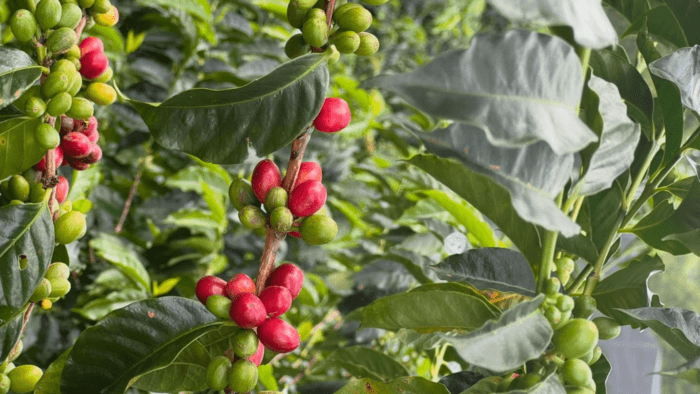
Arabica varieties account for approximately 98 percent of planted area, grown almost entirely under shade. About one‑third of Arabica plantations have been renovated with rust‑tolerant hybrids.
The remaining 2 percent consists of Robusta varieties, which are grown at lower altitudes.
The National Coffee Association (ANACAFE) continues to play a key role in ensuring the availability of certified planting material. Catimor and Caturra varieties make up nearly half of total plantings, followed by Catuai, Sarchimor, Bourbon, and others.
Producer Structure and Yield Trends
The Guatemalan coffee sector is dominated by small‑scale producers. Small growers (97 percent of producers) produce roughly 266 60 kg bags of parchment coffee annually, with average yields of 17.29 bags per hectare. Medium growers (2.9 percent) produce up to 172.9 bags annually at 18.62 bags per hectare. Large growers (0.1 percent) produce more than 173 bags annually, with yields exceeding 21.28 bags per hectare.
Yields in 2026/2027 are projected to increase slightly to 9.45 60 kg bags per hectare, above the 9.33 bags estimated for 2025/2026 but below the 9.67 bags achieved in 2024/2025.
The slight improvement reflects normal weather variations, though rising input costs remain a concern. As of March 2026, oil prices in Guatemala had increased by 20 percent, which will affect fertilizer and chemical prices for the following season.
Pest and Disease Challenges
The 2024/2025 harvest experienced higher coffee rust pressure, with incidence reaching up to 20 percent during January through March. Those months recorded higher moisture and temperature than usual. ANACAFE maintains close monitoring of rust and other pests to recommend preventive controls.
In September 2025, ANACAFE reported the identification of the coffee borer Xylosandrus compactus (Eichhoff) in the departments of Zacapa, Retalhuleu, Quetzaltenango, and San Marcos at altitudes of 600 to 900 meters. The pest was first reported in 2024 on avocado and cedar but subsequently appeared scattered on some Robusta trees. ANACAFE has provided control measures, including natural and chemical controls, but manual control appears to be the most effective method to prevent spread.
Input Programs and Farmer Support
ANACAFE’s Sustainable Profit Program provides guidance on best agronomic practices, focusing on a progressive annual pruning management system over 3‑ to 5‑year cycles. In 2024/2025, more than 27,000 hectares were harvested under the program, with 52,565 hectares registered.
ANACAFE also operates an agricultural input program that leverages collective purchasing power to secure inputs at reduced prices. The 2026 inputs program includes biostimulants, fertilizers, foliar fertilizers, fungicides, organic products, and crop protection chemicals, with discounts ranging from $0.75 per 100 pounds on standard fertilizers to specific per‑liter prices for specialty products.
A coffee trust fund, created by Legislative Decree 31‑2001 and amended over time, granted loans totaling $180 million between 2001 and 2025. Beneficiary farmers have repaid $108 million in capital and $46 million in interest. Decree 4‑2019 extended the trust fund’s duration until October 23, 2051, enhancing banking services for the sector.
Domestic Consumption
Domestic coffee consumption is projected to reach 900,000 60 kg bags in 2026/2027, a 2.9 percent increase from the 2025/2026 estimate of 875,000 bags. Soluble coffee continues to grow at a faster pace (30 percent growth rate) and accounts for 67 percent of domestic consumption (600,000 bags). Roasted and ground coffee accounts for the remaining 33 percent (300,000 bags).
Exports and Key Markets
Guatemalan coffee exports (including bean, roasted, and soluble) are forecast at 3.2 million 60 kg bags in 2026/2027, a 7.4 percent increase from the revised 2025/2026 estimate of 2.98 million bags. Green coffee exports represent approximately 90 percent of total exports, while demand for soluble exports continues to increase.
The United States remains the main destination, with a 42 percent market share. Other significant markets include Japan, Canada, Belgium, Italy, and South Korea. By region, North America absorbs 52 percent of exports, followed by Europe (26 percent), Asia (20 percent), and the rest of the world (2 percent).
In 2024/2025, total export value reached $1.284 billion, with prices averaging above $300 per 60 kg bag. To improve the buying experience, customers can explore the website “Explore – Guatemalan Coffees,” which displays farm‑level information on the best coffees of the year, including location, regional classification, varieties, processing methods, and showcasing schedules.
Table 1: Guatemala Coffee Exports (1,000 60 kg bags)
| Destination | MY 2023/24 | MY 2024/25 | Share (2024/25) |
|---|---|---|---|
| United States | 1,294 | 1,198 | 41.9% |
| Japan | 308 | 330 | 11.5% |
| Canada | 360 | 273 | 9.5% |
| Belgium | 263 | 266 | 9.3% |
| Italy | 165 | 155 | 5.4% |
| South Korea | 147 | 111 | 3.9% |
| Germany | 131 | 96 | 3.4% |
| Others | 483 | 430 | 15.0% |
| Total | 3,151 | 2,859 | 100% |
Policy, Sustainability, and Trade Agreements
In calendar year 2025, coffee represented 3.3 percent of Guatemala’s GDP and was the main agro‑industrial export product, accounting for 8 percent of total agricultural exports. Coffee is grown in 261 of the country’s 340 municipalities and covers 3.5 percent of total cropland. ANACAFE, established under Decree 19‑69, is responsible for issuing export licenses and promoting the sector.
ANACAFE promotes compliance with international and national policies related to greenhouse gas reduction. Initiatives include promoting renewable energy, water resource management with treatment and re‑utilization of processing water, and active geospatial monitoring to prevent deforestation. Close to 99 percent of Guatemalan coffee plantations comply with the EU zero‑deforestation policy, supported by specific platforms developed by ANACAFE.
On November 18, 2025, Guatemala’s Congress ratified the free trade agreement with South Korea through Decree 18‑2025. South Korea has also completed its ratification. Under the agreement, green coffee was granted immediate market access, representing a significant opportunity for the coffee sector.
Domestic reference prices for washed Arabica coffee as of April 7, 2026, are: hard green bean $247.53 per 60 kg bag, strictly hard green bean $253.53, and specialty strictly hard $256.53. Cherry prices range from $32.72 to $38.93 per bag depending on grade.
Frequently Asked Questions
How much coffee will Guatemala produce in 2026/2027?
Production is forecast at 3.13 million 60 kg bags, a 3.3% increase from the previous year.
What is the main export market for Guatemalan coffee?
The United States is the largest market, accounting for 42% of total exports.
What pests and diseases affect Guatemalan coffee?
Coffee rust (reaching 20% incidence in early 2025) and the coffee borer (Xylosandrus compactus) detected in four departments.
What percentage of Guatemalan coffee is grown under shade?
Almost 98% of Arabica coffee is grown entirely under shade.
How much of Guatemala’s domestic consumption is soluble coffee?
Soluble coffee accounts for 67% of domestic consumption (600,000 out of 900,000 bags).
What is ANACAFE’s role?
ANACAFE is the National Coffee Association, established under public law to enhance coffee production, marketing, and exportation, and it issues export licenses.
Author: Qahwa World – Guatemala City | Source: USDA Foreign Agricultural Service – Report GT2026-0003 | Date: April 16, 2026