Author: Qahwa World – Dubai
Date: May 24, 2026
Coffee Kombucha: New Study Finds Coffea arabica Infusion Viable Alternative to Traditional Tea
Executive Summary
- Researchers evaluated replacing green tea with Coffea arabica infusion (25% to 100%) for kombucha fermentation.
- Coffee substitution reduced sugar consumption but did not significantly affect final pH (2.8 to 3.2) or titratable acidity (approximately 0.4).
- Higher coffee proportions reduced acetic acid bacteria and increased lactic acid bacteria, shifting metabolism toward lactic acid production.
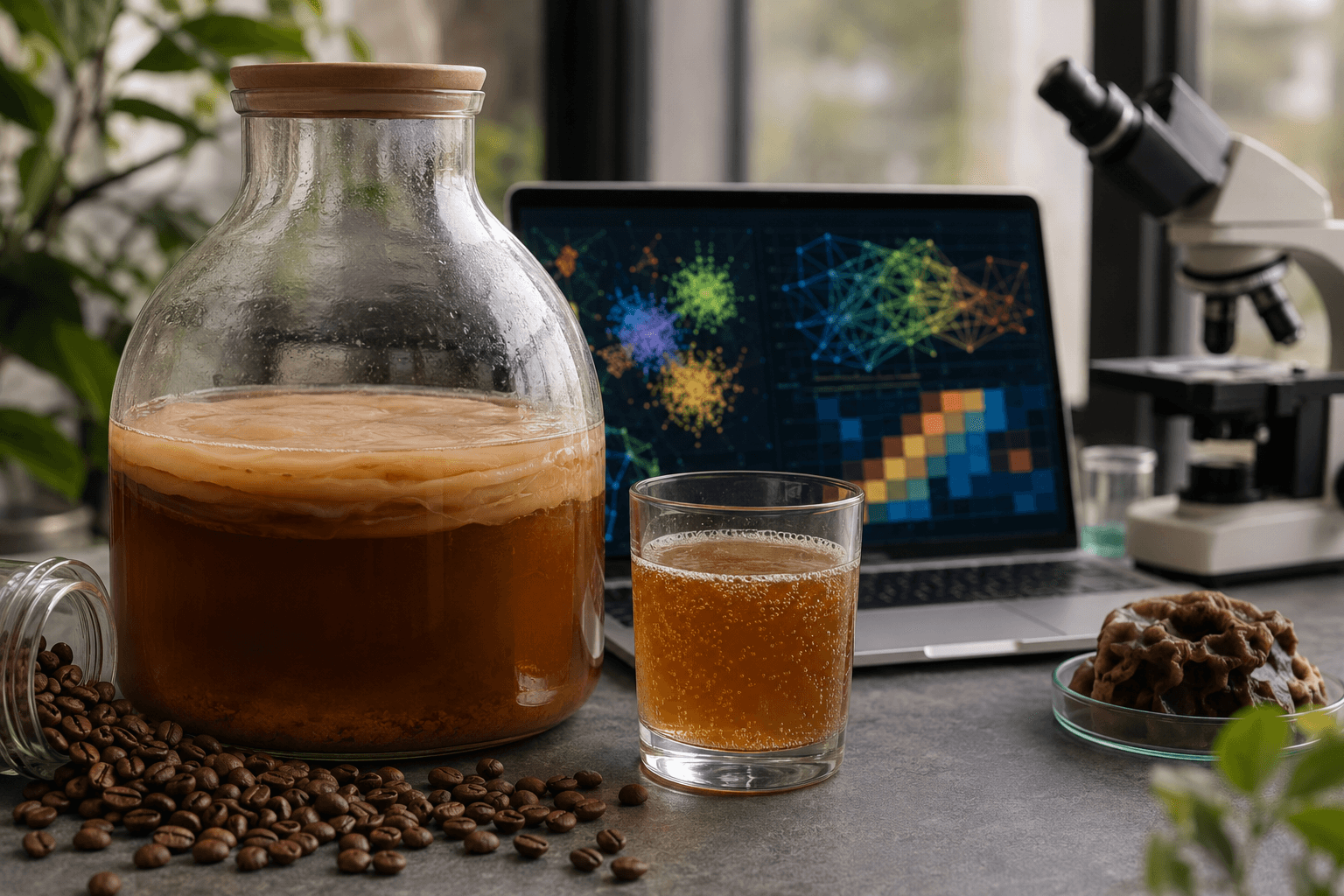
- SCOBY structure remained intact, with a more porous cellulose network in coffee-based formulations.
- 100% coffee kombucha maintained stable total phenolic content and antioxidant capacity after fermentation.
- Machine learning identified coffee-specific biomarkers linked to lactic acid and aroma-active compounds among 111 volatile compounds detected.
From Tea to Coffee: A New Frontier for Kombucha
Kombucha is traditionally fermented from sweetened Camellia sinensis tea using a symbiotic culture of bacteria and yeasts (SCOBY). However, a new study published in the Journal of Food Science explores whether Coffea arabica infusion can serve as a viable alternative substrate. The research, led by Paulo Sérgio Pedroso Costa Júnior and Dirceu de Sousa Melo, with contributions from Victor Hugo Buttrós, Karina Teixeira Magalhães-Guedes, Disney Ribeiro Dias, and Rosane Freitas Schwan, evaluated coffee substitution levels from 25% to 100% during kombucha fermentation.
The findings open new possibilities for product diversification in the functional beverage market. Coffee-based kombucha maintained fermentation performance and safety while offering distinct microbial, chemical, and sensory profiles.
Fermentation Kinetics and Acidity Profile
The study found that substituting green tea with coffee reduced sugar consumption rates. However, final pH values remained within the typical range for kombucha (2.8 to 3.2), and titratable acidity stayed stable at approximately 0.4. This indicates that coffee-based formulations can achieve the same level of acidity required for product safety and preservation.
Increasing coffee proportions significantly reshaped microbial populations. The most notable change was a reduction in acetic acid bacteria and an increase in lactic acid bacteria. This shift redirected metabolism toward lactic acid production, creating a different organic acid profile compared to traditional tea kombucha.
| Parameter | Traditional Tea Kombucha | 100% Coffee Kombucha |
|---|---|---|
| Final pH | 2.8 to 3.2 | 2.8 to 3.2 (stable) |
| Titratable acidity | ~0.4 | ~0.4 (stable) |
| Dominant bacteria | Acetic acid bacteria | Lactic acid bacteria |
| SCOBY cellulose network | Standard density | More porous |
| Total phenolic content after fermentation | Decreased | Stable |
SCOBY Structure and Functional Attributes
Structural analyses revealed that SCOBY integrity remained preserved in all coffee-based formulations. However, researchers observed a more porous cellulose network in coffee kombucha compared to traditional tea kombucha. This structural difference may influence future applications of the fermented pellicle in food products or other industries.
Total phenolic content decreased after fermentation in most treatments. Notably, the 100% coffee kombucha maintained stable phenolic levels and preserved antioxidant capacity. This suggests that full coffee substitution may offer functional advantages over partial substitution or traditional tea.
Gas chromatography-mass spectrometry (GC-MS) analysis identified 111 volatile compounds across all samples. Using multivariate and machine learning approaches, researchers identified coffee-associated biomarkers linked to lactic acid and several aroma-active compounds. These biomarkers could serve as quality markers for coffee kombucha production.
Practical Applications for Beverage Manufacturers
The study’s practical applications are significant for the functional beverage industry. Coffee-based kombucha enables manufacturers to develop products with differentiated microbial, chemical, and sensory profiles without requiring major changes to conventional SCOBY-based processes.
Coffee infusion promotes a shift toward lactic acid-oriented fermentation, distinct aroma signatures, and preserved functionality. This offers a feasible strategy for product diversification. Manufacturers can modulate fermentation outcomes simply through raw material selection, supporting the development of innovative, scalable, and consumer-oriented kombucha beverages.
The research demonstrates that Coffea arabica infusion is a suitable alternative substrate for kombucha fermentation. It enables substrate-driven modulation of microbial dynamics and metabolic profiles while maintaining product safety and functional potential.
Frequently Asked Questions (FAQ)
1. Can coffee completely replace tea in kombucha fermentation?
Yes. The study found that 100% Coffea arabica infusion successfully supports kombucha fermentation while maintaining safety and functional properties.
2. How does coffee kombucha differ from traditional kombucha?
Coffee kombucha shifts microbial populations from acetic acid bacteria to lactic acid bacteria, resulting in different organic acid profiles. It also produces distinct aroma compounds and maintains antioxidant capacity better than some tea-based versions.
3. Does coffee kombucha have the same acidity as traditional kombucha?
Yes. Final pH values ranged from 2.8 to 3.2, and titratable acidity was approximately 0.4 for both traditional and coffee-based kombucha.
4. What happens to the SCOBY structure in coffee kombucha?
SCOBY integrity is preserved, but the cellulose network becomes more porous compared to traditional tea kombucha.
5. How many volatile compounds were identified in the study?
GC-MS analysis identified 111 volatile compounds. Machine learning helped identify coffee-specific biomarkers linked to lactic acid and aroma-active compounds.
6. Is coffee kombucha commercially feasible?
Yes. The study confirms that coffee infusion is a feasible strategy for product diversification without requiring significant changes to conventional SCOBY-based processes.
Source: Journal of Food Science (DOI: 10.1111/1750-3841.71117) |
Publication date: May 24, 2026