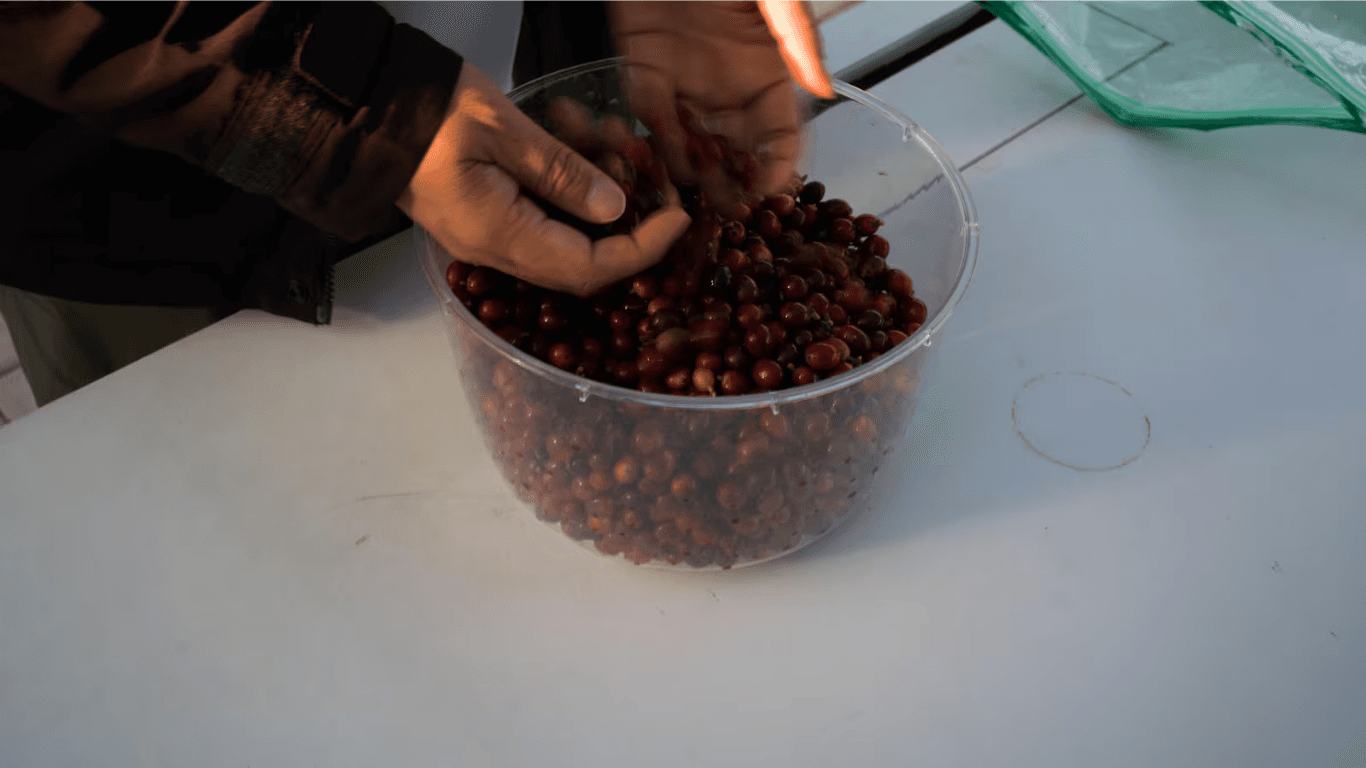
- Hong Kong, a city of 7.5 million people, has begun growing coffee on Lantau Island despite urban conditions.
- Ringo Lam, a former tech entrepreneur, started the project after bringing 100 coffee seeds from Panama six years ago.
- About 80 of the 100 seeds sprouted, and now 25 farmers nurture approximately 400 coffee trees on Lantau.
- The 2026 harvest yielded 10 kilograms of coffee cherries, nearly ten times the first harvest in 2023.
- Hong Kong sits at 22 degrees north of the equator, within the global coffee belt, but lacks altitude for complex flavors.
- Local coffee tastes smooth but less complex than specialty brews from traditional growing regions.
- Farmers aim to raise awareness about sustainable farming and fair pay rather than compete with major producers.
A coffee roaster hums like an idling train in the attic of LCC Roastery on Hong Kong‘s Lantau Island. Owner Ringo Lam proudly displays a jar labeled “Lantau Bean,” which represents a daring dream: growing coffee in the shadow of a metropolis. For decades, Hong Kong has imported nearly all its food and beverages. But a small group of farmers and enthusiasts is proving that coffee can indeed thrive on this densely populated island.
Ringo Lam, 55, previously worked as a tech entrepreneur. He now collaborates closely with farmers on Lantau, an island known for its greenery and relaxed lifestyle. The island sits just a 30 minute ferry ride from Hong Kong’s bustling city center. Lam’s goal is to cultivate the city’s own coffee beans and change public perception about what is possible in urban agriculture.
The Coffee Belt and Hong Kong’s Position
Asia produces some of the world’s finest coffee, mainly in the southeastern part of the continent. Countries like Vietnam and Indonesia benefit from tropical climates. In East Asia, coffee consumption has grown rapidly over the past decade. However, less favorable conditions, including annual periods of extreme cold, have limited crop development in countries such as Japan and China. Only a few high-altitude areas like Yunnan in mainland China or the Alishan Mountain Range in Taiwan can grow premium Arabica coffee.
Hong Kong, a Chinese city with 7.5 million residents, has more than 700 cafes. Yet it has never been seen as an ideal location for coffee cultivation. The city has a stronger cultural attachment to tea. Exorbitant land prices make it more logical to import almost all food rather than grow it. Despite these challenges, Lam’s project has succeeded.
Katie Chick, an arboriculture instructor involved in running a coffee farm linked to the University of Hong Kong, explains that coffee trees thrive within the so called “coffee belt,” approximately 25 degrees north and south of the equator. Hong Kong sits at 22 degrees north, placing it just inside that band. “Geographically speaking, Hong Kong is fit to grow. We just lack a bit of altitude,” Chick said.
From Panama Seeds to Lantau Harvest
Lam’s journey began six years ago during a trip to Panama. He visited farmers to study the coffee industry and received 100 coffee seeds to take home. Not every seed will sprout, and coffee plants often take two to three years to bear fruit. “Out of all those 100 seeds, about 80 something came out,” Lam said. He called every farmer he knew on Lantau Island, asking them to take in the seedlings.
Initially, five farmers agreed. More joined later through trial and error. Today, 25 farmers nurture about 400 coffee trees on Lantau Island. Earlier this year, they harvested their largest batch of coffee cherries yet, measuring 10 kilograms. That amount is nearly ten times their first yield in 2023. An annual gathering now brings together local coffee farmers to brainstorm ways to refine their techniques.
Limited Yields and Commercial Viability
Despite this success, these farmers are not seeking to compete with Latin America or Southeast Asia. The high costs of production make large scale coffee farming hardly commercially viable in Hong Kong. The record 10 kilogram harvest would not fill a single 60 kilogram bag, which is the industry’s basic unit of trade. By comparison, farmers in Brazil, the world’s largest coffee grower, produced 63 million of those bags last year according to the United States Department of Agriculture.
CNN sampled two separate Hong Kong grown coffees. The taste was smooth and easy to drink, though lacking the complexity of specialty coffee from traditional regions. This forces local producers to innovate. They experiment with different wash processes and hold workshops to build awareness, hoping to maximize the value and impact of their home grown crops.
Key Data: Hong Kong Coffee Farming
| Indicator | Value |
|---|---|
| Coffee trees on Lantau Island | 400 |
| Number of farmers involved | 25 |
| 2026 harvest (cherries) | 10 kg |
| First harvest (2023) | 1 kg (approx) |
| Hong Kong latitude | 22 degrees north |
| Coffee belt range | 25 degrees north to 25 degrees south |
| Farmer income per kg of beans | 2 to 3 US dollars |
Building Awareness and Fair Pay
Mike Sim, founder of Seed to Cup, a group that promotes local coffee, has rented a farm in Fanling, northern Hong Kong. He works to perfect his beans while running educational workshops. Last year, he partnered with a barista in a coffee making contest to showcase a batch he grew, mixed with Colombian varietal. They did not win, but Sim called it a big step forward. “We showed people that there are farms in Hong Kong now working with baristas,” he said.
Chan Fung-ming, one of Lam’s Lantau farmers, quit her job as a social worker to take over her family’s farm. Specializing in horticultural therapy, she advocates using gardening to improve well being. She hopes to use coffee to introduce farming to young people. “I think it’s a medium to bring people into the world of planting,” she said.
Lam runs a workshop that lets participants pick coffee cherries and process them from scratch. He says this offers visitors a taste of the hard work that farm workers in distant regions endure every day. For every kilogram of beans, which can produce about 44 cups of coffee, farmers receive only 2 to 3 US dollars. Lam believes that after attending his workshop, people become more willing to pay a fair price for coffee.
Frequently Asked Questions (FAQ)
1. Can coffee really grow in Hong Kong?
Yes. Hong Kong sits at 22 degrees north, within the global coffee belt. Farmers on Lantau Island have successfully grown coffee trees, with a harvest of 10 kilograms of cherries in 2026.
2. How did the Hong Kong coffee project start?
Ringo Lam brought 100 coffee seeds from Panama six years ago. About 80 sprouted, and he distributed them to farmers on Lantau Island. Today, 25 farmers grow about 400 trees.
3. How does Hong Kong grown coffee taste?
According to CNN samples, Hong Kong coffee is smooth and easy to drink, but less complex than specialty coffee from traditional high altitude regions.
4. Why doesn’t Hong Kong produce coffee commercially?
Land is extremely expensive, production costs are high, and yields are very small. The entire 2026 harvest was only 10 kilograms, far below commercial scale.
5. What is the goal of these coffee farmers?
They aim to raise awareness about sustainable farming, fair pay for workers, and reconnect city dwellers with the origins of their coffee, not to compete with major producers.
6. How much do coffee farmers earn per kilogram?
Farmers typically receive about 2 to 3 US dollars per kilogram of beans. One kilogram produces approximately 44 cups of coffee.
Published: May 17, 2026