Author: Qahwa World |
Date: June 28, 2026
US Military Turns Coffee Waste into Field Explosive Charges
Key Takeaways:
- The Pentagon reveals successful field tests by US Marines in manufacturing explosive charges using locally available materials such as coffee waste, coconut fibers, volcanic rock, and recycled plastic bottles.
- The tests used 3D printers and mobile manufacturing equipment in the Indo-Pacific region.
- Field-produced charges achieved 25% better concentration characteristics compared to traditional factory-made explosives.
- The military aims to reduce manufacturing time by up to 99% and reduce reliance on vulnerable long supply chains.
- The project is inspired by lessons from the Ukraine war on rapid development and production of military technologies during combat.
- The strategy includes deploying mobile manufacturing units to operational areas and making government patents available to the private sector.
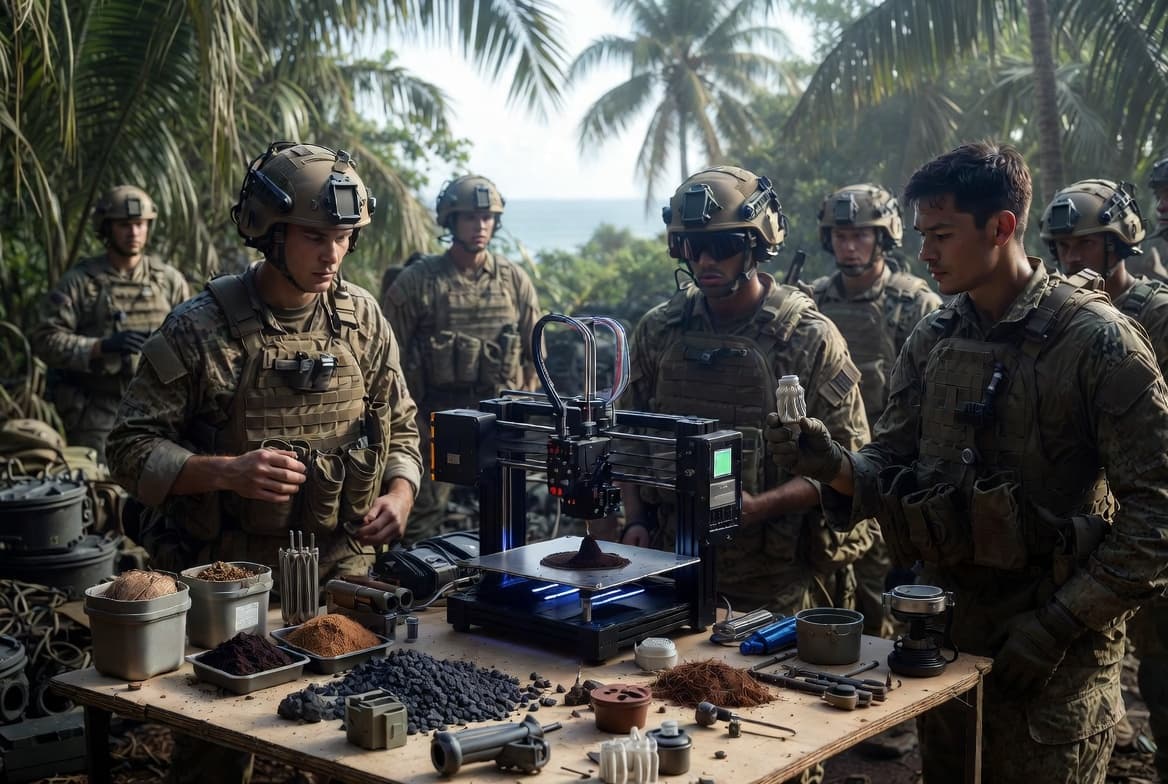
A senior Pentagon official has revealed successful field tests conducted by US Marines in manufacturing explosive charges using locally available materials such as coffee waste, coconut fibers, volcanic rock, and recycled plastic bottles.
The announcement came during the Defense One Tech Summit held on Tuesday, June 16, 2026, in Arlington, Virginia. Joseph Jewell, Assistant Secretary of Defense for Science and Technology, showcased the project as a living example of the Pentagon’s new direction toward rapid field manufacturing.
Successful Test Details: Coffee and 3D Printers
US units used mobile manufacturing equipment and 3D printers to produce explosive charges in the Indo-Pacific region. Jewell said: “All of the test models exploded successfully, and volcanic rock was the most effective. The amazing thing is that this was manufactured with a 3D printer. You reduce the time to point of use by up to 99 percent, using materials readily available in the local environment.”
Jewell added that the field-produced charges achieved 25% better concentration characteristics compared to traditional factory-made explosives. This performance improvement reflects the ability of field manufacturing to adapt formulations according to local conditions and available materials.
| Material | Source | Effectiveness |
|---|---|---|
| Coffee Waste | Daily waste | High |
| Coconut Fibers | Natural local materials | High |
| Volcanic Rock | Geological materials | Most effective |
| Recycled Plastic Bottles | Plastic waste | Medium to high |
Lessons from Ukraine: Speed of Development During Combat
Jewell directly linked these tests to lessons learned from the Russia-Ukraine war, which demonstrated the ability of armies to develop, produce, and deploy new technologies during active combat. He noted that Ukraine successfully built a vast drone industry at record speed, prompting the Pentagon to reassess its traditionally slow research, development, and manufacturing strategies.
The war in Ukraine showed that long supply chains can be a significant vulnerability, and the ability to manufacture rapidly in the field gives forces a decisive advantage on the battlefield. This lesson has driven the Pentagon to adopt the “point-of-use manufacturing” model as a strategic priority.
Future Vision: Mobile Manufacturing at Point of Use
The new US vision relies on deploying mobile manufacturing units that can be transported to operational areas, enabling forces to produce their needs directly in the field. This model aims to reduce risks from targeting long supply chains, especially in a large-scale conflict scenario in the Indo-Pacific region, where US units are dispersed across remote islands that are difficult to support logistically.
The broader strategy includes strengthening collaboration with universities and the private sector, investing in artificial intelligence and biomanufacturing, and making hundreds of government patents freely available to defense companies to accelerate the transformation of ideas into field applications.
| Benefit | Impact |
|---|---|
| Manufacturing time reduction | Up to 99% compared to traditional methods |
| Improved explosive performance | 25% better concentration |
| Use of local materials | Reduced supply chain dependence |
| Reduced logistical risk | Protection from supply targeting |
| Operational flexibility | Ability to adapt to local conditions |
Collaboration with Private Sector and Universities to Accelerate Innovation
The Pentagon’s broader strategy includes strengthening collaboration with universities and the private sector, investing in artificial intelligence and biomanufacturing. Additionally, the department has announced it will make hundreds of government patents freely available to defense companies, aiming to accelerate the transformation of ideas into deployable field applications.
This step reflects a fundamental shift in Pentagon philosophy, from a slow, closed research and development model to an open, rapid model that relies on partnerships with the private sector and academia. The ultimate goal is to ensure US forces can adapt quickly to evolving battlefield challenges.
Frequently Asked Questions About Coffee Waste Explosives
Q: How can coffee waste be turned into explosives?
A: Coffee waste is used as a carbon material in explosive formulations. It is combined with other materials and processed using 3D printers to produce effective explosive charges.
Q: Is this technology safe for field use?
A: Yes. All test models exploded successfully in field tests, showing better performance than traditional explosives in some characteristics.
Q: What are the main advantages of field manufacturing?
A: Manufacturing time reduction of up to 99%, improved explosive performance, reduced dependence on long supply chains, and increased field flexibility.
Q: How do forces benefit from Ukraine war lessons?
A: Ukraine demonstrated the ability to develop and produce new technologies during combat, prompting the Pentagon to adopt a faster, more flexible manufacturing model.
Q: What other materials are used in these tests?
A: Materials include coconut fibers, volcanic rock, and recycled plastic bottles.
The project to convert coffee waste into explosive charges represents a paradigm shift in the concept of military field manufacturing. By utilizing local materials and 3D printing technologies, the Pentagon aims to build a more resilient force less dependent on traditional supply chains. This model, inspired by lessons from modern warfare, may redefine how armies are equipped in the future.
Prepared and edited by: Qahwa World – Based on statements by the Assistant Secretary of Defense for Science and Technology at the Defense One Tech Summit, June 16, 2026.
All rights reserved. Republication with attribution permitted.
Publication date: June 28, 2026