Dubai – Qahwa World
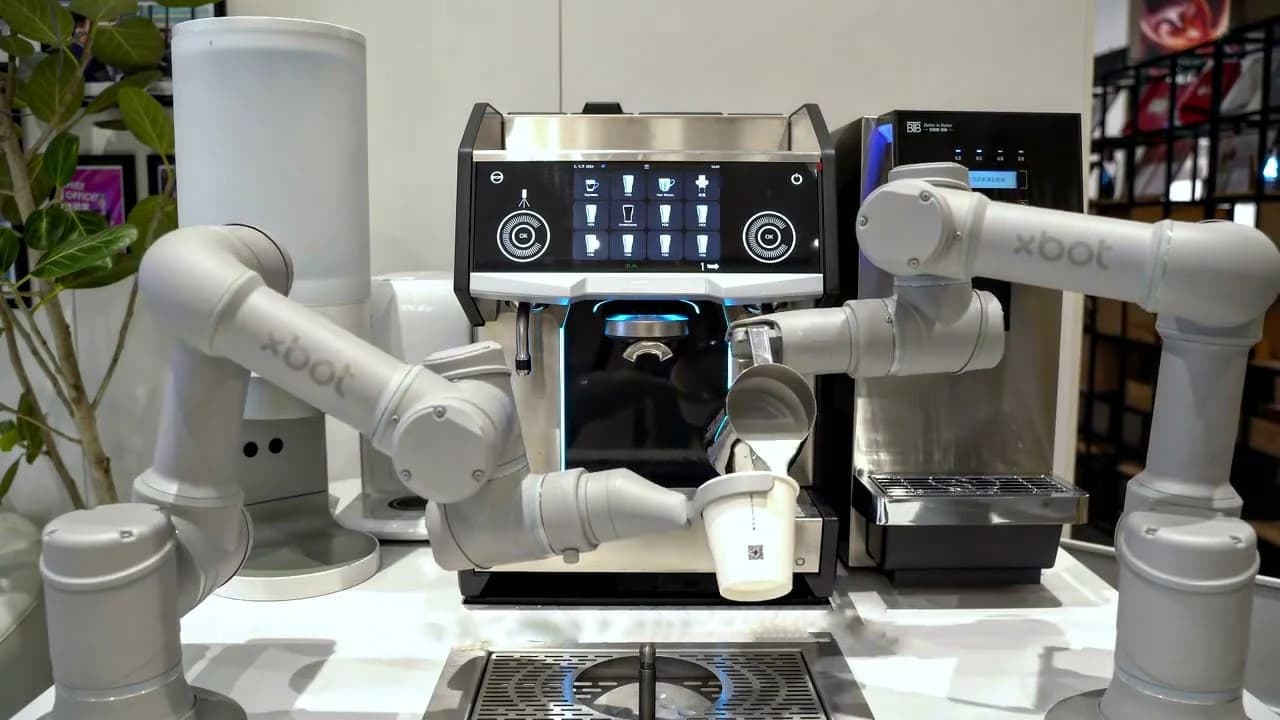
Humanoid robots may be able to perform martial arts routines, navigate obstacle courses, and impress audiences with highly choreographed demonstrations. But according to robotics experts, the true measure of progress lies not in spectacle, but in the ability to handle simple, everyday tasks—such as preparing a cup of coffee.
This perspective was at the center of a panel discussion among robotics leaders during the World Economic Forum in Davos, where speakers argued that the industry must move beyond polished demonstrations and focus on real-world usefulness if humanoid robots are to achieve meaningful adoption.
Jake Loosararian, Chief Executive Officer of an infrastructure-focused robotics company, emphasized that deployment—not design—is currently the sector’s biggest challenge. He noted that while public attention has fueled rapid innovation, many humanoid robots remain confined to controlled environments, far from the unpredictable conditions of daily life.
According to Loosararian, the lack of reliable, real-world data limits the ability of robots to operate effectively outside the lab. Building and testing robots as close as possible to their intended working environments is essential, he said, as this provides insights that cannot be replicated through simulations or online datasets. Tasks such as making coffee expose robots to variables like changing surfaces, lighting conditions, liquid handling, and human interaction—details that are critical yet often underestimated.
Daniela Rus, Director of the Computer Science and Artificial Intelligence Laboratory at the Massachusetts Institute of Technology, highlighted the gap between laboratory success and real-life performance. While robots can be programmed to fold laundry or load dishwashers, she explained, achieving this reliably in real environments remains extremely complex and costly. Bridging this gap will require advances in perception, sensor technology, and artificial intelligence models capable of adapting to unfamiliar situations.
From an industrial perspective, Shao Tianlan, Chief Executive Officer of a China-based artificial intelligence and robotics firm, pointed to learning as a key obstacle. He argued that for humanoid robots to function effectively in factories and service environments, they must be able to learn directly from humans—through demonstration and observation—much like people teach one another. This approach, he said, is more intuitive and practical than relying solely on pre-programmed instructions.
Despite ambitious predictions from technology companies preparing to scale humanoid robot production, most robots today are still showcased in tightly controlled settings. Some demonstrations even rely on remote human operators rather than full autonomy, underscoring how far the technology still has to go.
In this context, coffee becomes more than a beverage—it becomes a benchmark. Preparing coffee requires precision, coordination, adaptability, and an understanding of tools and materials. It is a deceptively simple task that reveals whether robots are ready to move from staged performances into real kitchens, cafés, and workplaces.
As the industry continues to evolve, the question remains open: can humanoid robots transition from impressive demonstrations to genuine daily assistance?
For now, a cup of coffee may be the most honest test of all.